
“Claire, please sit down. I don’t know how to tell you this.”
My sister, Nora, stood in my doorway with a crumpled envelope pressed against her chest.
Her eyes were swollen.
“What happened? Where’s Ellie?”
“She’s home with Tom.”
“Is she hurt?” I pressed.
“No. She’s fine.”
Nora came inside but wouldn’t sit.
She kept smoothing the envelope with her thumb.
“Nora, you’re frightening me.”
“I know. I’m sorry.” She pushed the envelope toward me. “You won’t believe what I found out about this child.”
She finally sat at my kitchen table.
“You remember what the adoption agency told us about Ellie?”
“That she was found as a baby,” I replied. “They couldn’t identify her parents.”
Nora nodded.
“That’s not true.”
I pulled out a chair.
“What do you mean?”
“They’ve been reviewing some of her early records. There were things missing from her medical history, so Tom and I asked them to check.”
“And?”
“They found something.”
She pushed the envelope toward me.
I didn’t open it immediately.
***
Two weeks earlier, I’d helped Nora arrange pink curtains in Ellie’s new bedroom.
Now my sister looked as though someone had threatened to take that entire room away.
Eight years of trying to have a baby had nearly broken Nora.
There had been fertility appointments, disappointing test results, and birthdays when she couldn’t bear to attend children’s parties.
When I suggested adoption, she was hesitant.
“What if I can’t love a child who isn’t mine?” she’d asked.
I told her love wasn’t something a blood test could measure.
Eventually, she and Tom began the process.
Two weeks before Nora appeared at my door, Ellie’s adoption had been finalized and she came home with Nora and Tom. Nora called me six times that first day.
She wanted to know whether five-year-olds should still nap, how to get paint out of clothes, and whether it was normal for Ellie to ask the same question repeatedly.
I’d wanted that happiness for her more than anything.
Especially after losing my own daughter.
Five years earlier, I’d given birth to a little girl.
She was premature and needed immediate medical attention.
I saw her for only a moment before the nurses took her to intensive care.
I remember a tiny hand moving beside her face.
I remember asking whether I could hold her.
They told me they needed to stabilize her first.
The following morning, a doctor came into my room.
He said my baby hadn’t survived.
Her name was Lucy.
I’d chosen it months before she was born.
I went home without her.
For years afterward, I kept her hospital bracelet in a small box beside my bed.
I never found the courage to try for another child.
So when Nora first brought Ellie to meet me, I wasn’t prepared for how much it would hurt.
***
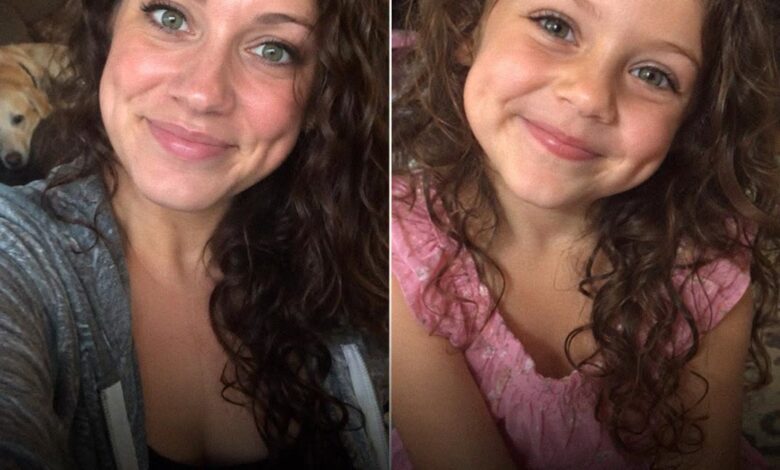
Ellie had dark curls, enormous brown eyes, and a tiny dimple in her left cheek.
I’d had that same dimple as a child.
“Look at her!” Nora laughed. “She could be one of us!”
I smiled.
But later, alone in my car, I cried.
I’d imagined Lucy growing up with curls like mine.
I’d imagined helping her get dressed for school.
Ellie looked so much like the little girl in those dreams.
Then Ellie decided she liked me.
She called me Auntie Claire.
Whenever I visited, she brought me two hair ribbons and asked for pigtails.
“Not one braid,” she’d instruct. “Two.”
“Yes, ma’am.”
“And don’t pull.”
“I’ll try.”
She’d sit on a kitchen chair, swinging her feet while I worked.
Once, she asked whether I had any children.
I told her I’d had a little girl who died when she was a baby.
Ellie thought about that.
“That’s sad.”
“Yes, sweetheart.”
Then she handed me a pink ribbon.
“This one’s for the left side.”
Children have a way of bringing you back to whatever needs doing.
***
Now Nora was sitting across from me, looking at the envelope.
“What did they find?” I asked again.
She opened it.
Several papers slid onto the table.
The first was a formal notice from the adoption agency.
It said Ellie’s early placement summary contained material inaccuracies.
I read the sentence twice.
“What inaccuracies?”
Nora pointed to the next page.
It was a summary of a records review.
A hospital name appeared halfway down.
I recognized it immediately.
It was the hospital where I’d delivered Lucy.
I looked at Nora.
“Why is this here?”
“Keep reading.”
The document described an unidentified newborn girl who had entered emergency protective care five years earlier.
There were discrepancies between the hospital’s records and the paperwork used when the child entered the care system.
The date listed was the same week Lucy was born.
I pushed the paper away.
“No.”
Nora reached for my hand.
“Claire…”
“No. That doesn’t mean anything. Babies are born there every day.”
“I know.”
“Lots of children could’ve come from that hospital.”
“Claire…” Her voice broke. “That’s what I told myself.”
She pulled out the final pages.
“When I saw the hospital and the dates, I asked whether they could check for a family connection.”
I stared at her.
“What did you check, Nora?”
“Tom and I worked with the caseworker. After you agreed to provide that cheek swab last week, they arranged a preliminary family-relationship test. They told us it might help clarify Ellie’s medical history.”
I remembered signing the consent form and giving the cheek swab. Nora had explained that the records review suggested a possible family connection, though nobody could tell us how close it might be.
I’d agreed because Ellie deserved an accurate medical history. I’d never imagined what the result might say.
Nora slid the report toward me.
I read the names.
Mine.
Ellie’s.
Then the conclusion.
The preliminary genetic comparison indicated a parent-child biological relationship.
I read it again.
“That’s impossible.”
Nora began crying.
“Claire, I think Ellie is Lucy.”
I stood so quickly my chair scraped the floor.
“No.”
“I didn’t believe it either.”
“My daughter died.”
“I know what they told you.”
“I have her death certificate.”
Nora covered her mouth.
I walked to the sink and gripped its edge.
Outside, a delivery truck stopped at the neighbor’s house.
Someone laughed on the sidewalk.
I could hear every ordinary sound while the words on that report refused to make sense.
Finally, I turned around.
“Does Ellie know?”
“No.”
“Does Tom?”
“Yes. He’s the one who insisted we shouldn’t tell her anything until it’s checked properly.”
I returned to the table.
“Is this result certain?”
“It’s preliminary. They want an independent test and a full review of the records.”
“Then we don’t know.”
Nora nodded.
“We don’t know everything.”
I looked at the hospital name again.
“Who told the agency she was unidentified?”
“That’s one of the things they’re investigating.”
“How could they tell me my baby died if she didn’t?”
Nora shook her head.
“I don’t have that answer.”
I stared at the report.
I wanted to believe it.
I was terrified of believing it.
Five years was a long time to mourn a child.
It was also a long time for someone else to raise her.
“Do you hate me?” Nora whispered.
“What?”
“If she’s Lucy…”
“Nora, you didn’t know.”
“But I brought her home.”
“You brought home a little girl who needed parents.”
Tears ran down her cheeks.
I wasn’t ready to comfort her by promising nothing would change.
Something already had.
***
“Leave the papers with me,” I said.
She nodded.
Before she left, she turned at the door.
“Claire, whatever happens, I love her.”
“I know.”
Afterward, I took Lucy’s bracelet from my bedroom.
The plastic had yellowed slightly.
Her name was still printed across the front.
I placed it beside the report.
Two pieces of paperwork.
Two completely different accounts of the same child’s beginning.
For the first time in five years, I couldn’t tell which one to believe.
***
Over the following days, Nora, Tom, and I spoke with the adoption professionals handling the records review.
An attorney explained that even if the genetic connection was confirmed, it wouldn’t automatically settle the legal questions surrounding Ellie’s adoption.
Ellie would remain in her familiar home while the adults sought answers.
Whatever the records eventually proved, none of us wanted her to feel that loving one of us meant losing another.
I couldn’t bear the thought of frightening her.
We also requested the hospital records surrounding Lucy’s reported death.
An independent genetic test was arranged with proper consent.
Waiting for the results was miserable.
I still went to work.
I bought groceries.
I answered messages.
But every time my phone rang, I stopped whatever I was doing.
***
One afternoon, Nora sent me a photograph.
Ellie was sitting on the living room rug, building a tower from colorful blocks.
Her hair was in two crooked pigtails.
ELLIE DID THESE HERSELF , Nora wrote.
I enlarged the picture.
Ellie was smiling proudly.
I wanted to drive straight to Nora’s house.
Instead, I called her.
“How is she?”
“Good. She’s asking when you’re coming over.”
“Tell her soon.”
***
A week later, the independent result arrived.
This time, the report was clear.
The genetic findings confirmed that Ellie was my biological daughter.
I called Nora.
She answered immediately.
“Claire?”
“It’s confirmed.”
I heard her inhale.
Neither of us spoke for several seconds.
Then Nora said, “Come over.”
When I arrived, Tom opened the door.
He looked exhausted.
“She’s drawing in the kitchen,” he said quietly.
“Does she know?”
“No. We’re waiting for guidance on how to explain it.”
I nodded.
Then Ellie appeared.
“Auntie Claire!”
She ran toward me.
I bent down, and she threw her arms around my neck.
For a moment, I held the daughter I’d been told was dead.
Ellie pulled away and inspected my hair.
“Can you do mine like yours?”
“Of course, sweetheart.”
She fetched her ribbons.
I sat behind her at the kitchen table and divided her curls into two sections.
My fingers weren’t steady.
“Ouch!” she complained.
“Sorry, darling.”
“You’re pulling.”
I loosened my grip.
“Better?”
“Yep.”
Nora stood beside the counter, watching us.
I finished the first pigtail.
Then the second.
Ellie jumped down to inspect herself in the hallway mirror.
“Perfect!”
She ran off to show Tom.
Nora sat opposite me.
Neither of us reached for the papers on the table.
There was something much harder we needed to discuss.
Nora folded her hands on the table.
“Are you going to take her away?”
I looked toward the hallway where Ellie was showing Tom her pigtails.
“I don’t know what happens legally, Nora. But I’m not going to frighten her.”
Nora began crying.
“I’m afraid you’ll think I stole her.”
“You didn’t.”
“I finally have a daughter, Claire.”
“I know.”
“And she’s yours.”
I stared at the hairbrush between us.
“I’m afraid I’ll look at her and see everything I missed.”
Nora wiped her cheeks.
“You did miss it. And I can’t give it back.”
That hurt.
Because she was right.
I couldn’t recover Ellie’s first words or the birthdays I’d spent visiting a grave.
***
Two days later, our attorney called with an update.
The records review had identified two newborns whose hospital identification numbers appeared to have been transposed during a neonatal transfer.
One infant was recorded as deceased. Another had entered emergency protective care under incomplete identifying information.
Ellie’s earliest child-welfare record carried the number originally assigned to Lucy. But the identification-number discrepancy did not explain who had declared Lucy dead, how that death had been verified, or why the conflicting records had gone unchallenged. Investigators were examining each of those failures separately.
“Does that explain everything?” I asked.
“No,” the attorney said. “But it gives investigators a specific records trail to examine.”
The hospital had opened a formal investigation.
I requested every record concerning Lucy’s reported death.
I also asked who had verified her identity before issuing the certificate.
Nobody could answer that yet.
For once, I refused to accept a vague explanation.
Tom helped us arrange a meeting with a counselor experienced in adoption and complicated family histories.
We agreed Ellie would remain at home with Nora and Tom while the legal review continued.
We would tell her the truth carefully, with professional guidance, rather than let her overhear frightened adults discussing it.
***
That evening, Nora called.
“Are you angry with me?”
“Sometimes I’m angry at everyone,” I admitted. “But not because you love her.”
“Will you still come over?”
“Of course.”
***
Several weeks later, we were getting ready for a family outing.
Ellie appeared in the kitchen carrying two pink ribbons.
“Auntie Claire! Two pigtails, please.”
I pulled out a chair.
“Come here, then.”
She climbed up and handed me the ribbons.
Nora brought the hairbrush.
“She washed her hair this morning,” she warned.
Ellie groaned.
“Mommy, it’s not that tangled!”
“It was when I brushed it.”
“That’s because you brushed it wrong.”
Tom called from the hallway.
“Are we leaving today or next Tuesday?”
“Tuesday!” Ellie shouted.
I laughed and began separating her curls.
The first ribbon went in easily.
The second kept slipping.
“Too tight,” Ellie complained.
I loosened it.
“How’s that?”
She touched both pigtails.
“One’s higher.”
Nora leaned closer.
“She’s right.”
“Traitor,” I muttered.
Nora smiled and adjusted the ribbon.
Ellie hopped off the chair and ran toward Tom.
“Ready!”
He opened the front door.
She hurried outside, asking whether there would be ice cream afterward.
Nora picked up Ellie’s sweater.
“Claire? Coming?”
I put the brush down.
“Right behind you.”
She waited while I collected my purse.
Then we went out together.