
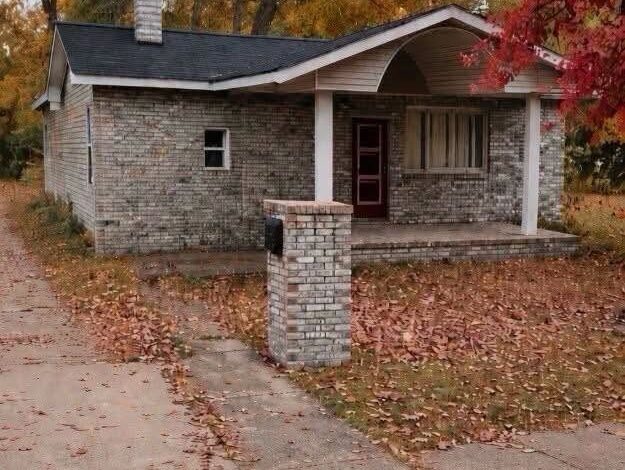
From the street, the home feels reassuring: a broad lot, classic ranch lines, and a stone facade that suggests permanence and care. The arched entry adds a touch of charm, hinting at a past when details mattered and families lingered on the front walk. Public schools and a developing neighborhood surround it, positioning the property as more than just a structure—it’s a potential foothold in a changing area.
Yet the terms are unapologetically stark. Cash only. As-is. No interior showings, no photos, limited inspections. Whoever buys this three-bedroom, two-bath house must commit largely on faith, trusting the roof’s recent replacement and the promise of “good bones.” It’s not a home for the cautious; it’s a canvas for someone who sees opportunity in uncertainty. For the right buyer, that locked door isn’t a warning—it’s an invitation to imagine what this stone-fronted shell could become.
The exterior and the sales conditions tell different parts of the same story. A stone facade and an arched entrance are visible features. The state of the interior is not. Keeping those two categories separate is essential to understanding what the listing actually establishes. Attractive details outside cannot answer every question about rooms that have not been shown.
The recently replaced roof is another specific detail, but it remains one part of a larger property. It does not, by itself, describe the plumbing, electrical systems, interior finishes, or other conditions inside. The account offers no basis for filling those gaps with either reassurance or an assumption that something must be wrong. The uncertainty is precisely what makes the terms so significant.
Cash-only and as-is conditions also shape the character of the offering. The listing is not presenting a conventional tour of a fully documented home. Instead, it pairs a modest asking price with unusually limited access. The three bedrooms and two bathrooms describe the stated layout, while the restrictions determine how much of that layout a prospective buyer can actually examine.
The broad lot and nearby schools provide setting rather than a complete assessment of value. They may be features someone notices first, but they do not resolve the unanswered questions behind the front door. A description can draw attention to a neighborhood and an exterior while still leaving substantial information unavailable.
That is the central tension of the property as presented. The house has a recognizable form and appealing visible details, yet its interior remains largely unknown. The account ends with that uncertainty rather than a demonstrated explanation for it. The stone frontage, the roof, and the unusual conditions all belong in the same picture; none should be allowed to stand in for information the listing does not provide.
The asking price is only one part of that description. It draws attention, but it cannot supply the missing interior information or explain why access is restricted. The most accurate picture is therefore an incomplete one: a visible stone ranch, a stated layout, a replaced roof, and sales terms that leave substantial questions unanswered. Those questions remain unresolved within the account.