
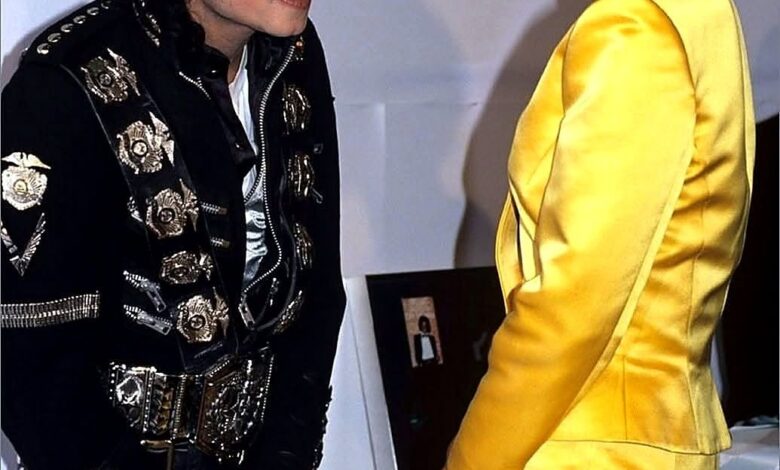
Two extraordinary figures. Two completely different worlds. And one unexpected connection that has continued to fascinate people decades later.
She was Princess Diana, one of the most recognizable women in the world. He was Michael Jackson, the global superstar whose music transformed popular culture. One belonged to the British royal family; the other became known as the King of Pop.
Yet behind the titles, the cameras, the screaming crowds, and the extraordinary attention surrounding their lives were two people who understood something surprisingly similar: what it meant to live while constantly being watched.
Their friendship was brief and unusual. They did not have decades of shared memories or a long history of private meetings. Instead, their connection grew from a small number of encounters and conversations, surrounded by an enormous amount of public attention.
And perhaps that is what makes their story so intriguing.
A Meeting That Became Part of Pop-Culture History
In July 1988, Michael Jackson was performing at Wembley Stadium in London as part of his enormously successful Bad tour.
The concert was already a major event.
Jackson was at the height of his international fame, and Wembley was one of the most iconic venues on the tour. Thousands of fans gathered to see him perform, while millions more around the world followed his career.
Among the distinguished guests that evening was Princess Diana.
By then, Diana had already become one of the world’s most recognizable public figures.
She was admired not only for her position within the British royal family but also for the warmth and accessibility she often displayed in public. Her interest in popular culture was also well known, making her appearance at a Michael Jackson concert particularly memorable.
Backstage, the two finally met.
What could have been nothing more than a formal celebrity encounter became one of the most remembered moments connecting two of the biggest personalities of the twentieth century.
At first glance, Diana and Michael Jackson seemed to have almost nothing in common.
Diana’s life was connected to the British monarchy, royal protocol, diplomacy, charity work, and public appearances.
Michael Jackson’s world revolved around music, dance, recording studios, international tours, and the extraordinary machinery of global entertainment.
Yet beneath those differences, their experiences contained some remarkable similarities.
Both had become famous on a scale that few people could fully understand.
Both struggled with the loss of privacy that came with extraordinary public attention.
Both were frequently photographed and discussed by the media.
Both had millions of admirers who felt as though they knew them personally.
And both discovered that extraordinary fame could sometimes be an extraordinarily lonely experience.
That shared understanding may have been one of the things that allowed them to connect.
One of the most frequently retold details from their meeting involves Jackson’s song “Dirty Diana.”
The song had been released on his Bad album, and it was part of the repertoire associated with the tour.
Because Princess Diana was in the audience, Jackson reportedly decided not to perform the song.
The reasoning was simple: he did not want the title to create an awkward situation or appear disrespectful toward the princess.
But the story took an amusing turn.
Diana reportedly told Jackson that she actually liked the song and would have been perfectly happy to hear it.
The moment has become one of the most memorable anecdotes surrounding their meeting.
It also reveals something about Diana’s public personality.
Despite her formal position, she could be playful and relaxed in situations where a more rigid interpretation of royal etiquette might have made an interaction uncomfortable.
For Jackson, the moment reportedly helped ease the formality surrounding their first meeting.
Instead of two famous people carefully navigating a ceremonial encounter, there was suddenly a simple human exchange between a performer and someone who genuinely enjoyed his music.
To understand why the encounter mattered, it is important to remember that Diana was not simply a member of the royal family.
She was also a major cultural figure.
Her fashion choices were followed around the world.
Her public appearances generated enormous media attention.
Her charitable work became an important part of her public identity.
And she had a particular ability to connect emotionally with people.
She frequently visited hospitals, charities, and organizations supporting vulnerable communities.
Her public approach often emphasized personal interaction rather than distance.
This contributed to the image that eventually earned her the widely used nickname “the People’s Princess.”
Her popularity was unusual for someone born into an institution defined by tradition and protocol.
And perhaps that made her connection with an entertainer like Michael Jackson feel less surprising than it initially appeared.
Michael Jackson had experienced fame from childhood.
He had become internationally famous as a member of the Jackson 5 before establishing one of the most successful solo careers in music history.
By the late 1980s, his fame was extraordinary.
Every public appearance could attract huge crowds.
Every new song could become an international event.
Every photograph could appear in newspapers and magazines around the world.
His private life was constantly examined.
That level of attention could create a strange contradiction.
A person can be recognized almost everywhere while still feeling that very few people truly understand them.
Jackson sometimes spoke about the pressures associated with fame and the difficulty of living under constant public scrutiny.
Diana knew that experience from a very different direction.
She too had discovered that becoming one of the world’s most recognizable people meant losing much of the privacy most people take for granted.
There is a temptation to turn their relationship into something more dramatic than the historical record supports.
The truth is more interesting precisely because it was relatively simple.
Diana and Jackson were not lifelong friends.
They did not share a decades-long friendship filled with countless documented meetings.
Their relationship appears to have been relatively limited in terms of personal contact.
But the encounters they did have became meaningful to both of them.
Jackson later spoke warmly about Diana, and their connection has often been remembered as one based on mutual affection and understanding.
The idea that two people at the absolute center of public attention could recognize something of themselves in one another is perhaps what makes the story endure.
Both Diana and Jackson were parents, and their children were enormously important parts of their lives.
Diana was the mother of Prince William and Prince Harry.
Jackson was the father of three children: Michael Joseph Jackson Jr., commonly known as Prince, Paris Jackson, and Prince Michael Jackson II, often known as Blanket.
Parenthood provided another point of common ground.
Behind their public identities, both were parents trying to protect their children from the enormous attention that surrounded their families.
For people whose own childhoods had been dramatically shaped by fame and public expectations, protecting their children could carry particular emotional weight.
Their conversations about family reportedly reflected this shared experience.
Diana and Jackson were both associated with charitable causes.
Diana became particularly well known for her humanitarian work, including her advocacy and public visits connected to HIV/AIDS awareness, homelessness, children, and landmine victims.
Jackson also supported numerous charitable organizations and humanitarian causes throughout his career.
His philanthropy included support for children, hospitals, humanitarian organizations, and other charitable initiatives.
Their charitable interests were not identical, and their approaches were shaped by very different circumstances.
But both understood the power of celebrity to draw attention to causes that might otherwise receive less public notice.
Their fame could open doors.
Their public appearances could generate media coverage.
And their names could attract attention to organizations and campaigns.
This may have been the deepest similarity between them.
Fame gave Diana and Jackson extraordinary opportunities.
It allowed them to influence conversations, support charitable causes, meet people from all over the world, and reach millions of people.
But fame also came with a cost.
There was almost no separation between their public and private identities.
A normal outing could become a news story.
A photograph could be reproduced thousands of times.
A rumor could travel around the world.
A moment of vulnerability could become public property.
For ordinary people, privacy is usually the default.
For Diana and Jackson, privacy often had to be actively protected.
That difference is difficult to understand unless you’ve lived under that level of attention.
Perhaps that was why their connection felt meaningful.
They didn’t need to explain the basic experience of fame to one another.
They already knew it.
Another reason the story has remained popular is the extraordinary symbolism surrounding the pair.
Princess Diana represented royalty, elegance, humanitarian work, and a changing relationship between the British public and the monarchy.
Michael Jackson represented music, performance, innovation, and global pop culture.
When they appeared together, the image seemed almost surreal.
The princess and the pop superstar.
The royal world and the entertainment world.
The woman known around the globe for her public compassion and the performer known for transforming the possibilities of popular music.
Their meeting was therefore much bigger in the public imagination than the length of their personal relationship might suggest.
On August 31, 1997, Princess Diana died following a car crash in Paris.
She was only 36 years old.
Her death shocked the world.
The public reaction was extraordinary, with millions of people mourning around the globe.
For many people, Diana had become more than a royal figure.
She represented compassion, vulnerability, modernity, and a more personal form of public service.
Her sudden death therefore felt deeply personal to people who had never met her.
Michael Jackson was reportedly deeply affected by the news.
Accounts of his reaction have circulated for years, including reports that he was devastated and that the tragedy affected his professional plans.
Whatever details are attached to those accounts, there is no question that Diana’s death was a major moment in the public life of the world.
Jackson later spoke about Diana with affection and sadness.
He remembered her not simply as a princess but as someone he considered a friend.
That distinction matters.
The world knew Diana through photographs, television appearances, charity events, royal ceremonies, and newspaper headlines.
Jackson had encountered another side of her.
He had spoken with her directly.
He had seen her away from the stage.
And he had experienced the warmth and humor that could emerge during a personal conversation.
That memory remained significant to him.
There was another similarity between them that shouldn’t be overlooked.
Both were often subjects of intense public speculation.
Their lives were interpreted through photographs, headlines, rumors, interviews, and commentary.
Sometimes the public image of a person becomes so large that the actual individual almost disappears behind it.
Diana was frequently described and analyzed in relation to her royal role.
Jackson’s life was constantly scrutinized as his fame grew.
Neither had complete control over the stories told about them.
This created a strange kind of shared experience.
The world might believe it knew everything about them.
But very little of what the public saw represented the entirety of their private emotional lives.
Perhaps one of the most appealing aspects of their story is that their connection didn’t depend on one person being more important than the other.
Diana didn’t need to impress Jackson.
Jackson didn’t need to impress Diana.
They were both already at the highest levels of international fame.
There was no obvious career advantage to the relationship.
Instead, the appeal seems to have been personal.
A conversation.
A shared laugh.
A mutual appreciation.
A sense of familiarity between two people who understood what it meant to be famous beyond anything most people could imagine.
Sometimes friendships don’t need years to become meaningful.
Sometimes a few genuine moments are enough to leave an impression.
The story of Diana and Michael Jackson is often presented as a glamorous celebrity anecdote.
But underneath the glamour is something much more human.
It reminds us that fame doesn’t eliminate ordinary emotional needs.
Even people surrounded by millions of admirers can want privacy.
Even people constantly photographed can feel misunderstood.
Even people who seem to have everything can value a conversation with someone who understands what they’re going through.
Diana had a royal title.
Jackson had worldwide musical fame.
But neither title completely defined who they were as people.
Strictly speaking, their friendship was not a conventional lifelong friendship.
Their documented personal encounters were limited.
Yet the story has survived because it represents something people instinctively understand.
Two extraordinarily famous people met at a moment when both were experiencing life at a scale that few others could comprehend.
Their worlds were different.
Their personalities were different.
Their careers were different.
But their experiences of fame had unexpected similarities.
And sometimes that is enough to create a connection.
Princess Diana died in 1997.
Michael Jackson died in 2009.
Their deaths were separated by nearly twelve years, but both generated enormous global reactions.
Diana’s death prompted one of the largest public expressions of grief in modern British history.
Jackson’s death similarly triggered an extraordinary worldwide outpouring from fans.
Both left behind children.
Both left behind enormous cultural legacies.
And both continued to be discussed long after their deaths.
Their stories have also been repeatedly revisited because each represented something larger than celebrity.
Diana became associated with a more personal, emotionally open image of public service.
Jackson became one of the most influential entertainers in modern popular culture.
There are countless celebrity friendships that have faded from public memory.
The connection between Diana and Jackson has endured for a different reason.
It combines two enormous cultural stories into one.
The princess and the pop star.
The royal world and the music industry.
A woman whose life was defined by public service and a performer whose career transformed entertainment.
But beyond the symbolism, people remember the humanity.
A princess who could laugh about a song with an unusual title.
A superstar who worried about causing offense.
Two people who understood the strange loneliness that can exist behind enormous fame.
That is perhaps why the story continues to resonate.
Princess Diana and Michael Jackson came from radically different backgrounds.
Their lives took them down completely different paths.
One entered the British royal family.
The other became one of the most famous musicians in history.
Yet their brief friendship demonstrates something surprisingly universal.
Fame doesn’t make people immune to loneliness.
Status doesn’t eliminate the need for genuine connection.
And sometimes, people who appear to live completely different lives discover that they understand one another better than almost anyone else can.
Their relationship may have lasted only a relatively short time, but the memory of it has lasted far longer.
Diana and Jackson were two extraordinary figures who lived under extraordinary scrutiny. Their meeting at Wembley became more than a photograph or a celebrity encounter. It became a small glimpse behind two enormous public personas.
Behind the princess was a woman looking for genuine human connection.
Behind the superstar was a man who understood the burden of being constantly watched.
And somewhere between the lights of Wembley Stadium, the roar of thousands of fans, and a simple conversation about a song, two of the world’s most recognizable people found a moment of ordinary humanity.
Two different worlds. Two unforgettable legends. And one remarkable connection that continues to fascinate people decades later.