
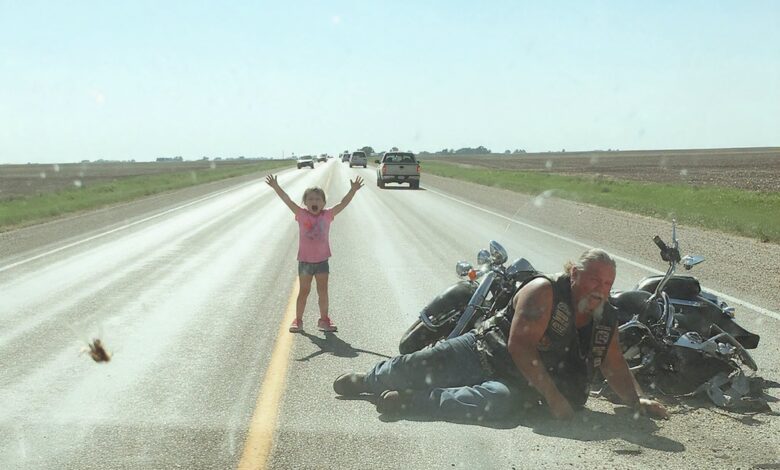
The biker was dying in the middle of the highway and nobody was stopping.
I counted at least thirty cars drive right past him before I finally pulled over.
He was on his side next to his wrecked Harley. His leg was bent the wrong way and there was so much blood it looked like someone had spilled a bucket of red paint across the asphalt.
But that’s not what made me get out of my car.
What made me get out was the little girl.
She couldn’t have been more than seven years old. Standing in the middle of the road waving her tiny arms at every car that came flying by. Screaming at them to stop. Screaming until her face was purple.
Most of those drivers just swerved around her like she was a traffic cone.
One guy actually honked at her.
By the time I ran over, her little pink shoes were soaked with the biker’s blood and she was holding his hand like he was her own daddy. Crying so hard she couldn’t breathe right. Still screaming at every car that passed.
I knelt down next to her and that’s when I noticed what she was clutching in her other hand.
A photograph. Old. Faded. Edges all torn up.
I asked her who the man on the ground was.
She looked up at me with those huge wet eyes and said something that stopped my heart cold.
She said, “He’s the man in this picture. I’ve been looking for him my whole life. Mommy told me if I ever found him, I had to tell him she kept her promise.”
My name is Dale. I’m fifty-four years old, I sell insurance in a little town outside Nashville, and until that Thursday afternoon in October, I’d never in my life pulled over to help a stranger on the side of the road. I always figured somebody else would stop. Somebody younger, somebody tougher, somebody who actually knew what to do with a wreck.
That day, something made me stop. I still can’t tell you exactly what it was. Maybe it was that little girl. Maybe it was the way she was running at those cars like a pink lightning bolt. Maybe I was just the thirty-first person who passed, and God decided enough was enough.
I pulled my phone out and dialed 911 while I was still kneeling in the gravel next to them. The dispatcher asked me what the situation was, and I had to look down at the man on the ground before I could even answer. He was awake. Barely. His eyes were half-open, locked on the little girl’s face like she was the only thing in the world keeping him in it.
He was a big guy, probably sixty years old, with a long grey beard and a leather vest with patches sewn all over it. One of the patches said “Vietnam Veteran.” Another one said “In Memory of Sarah.”
I told the dispatcher we had a motorcycle accident on Highway 29, mile marker 118, a male rider around sixty, open fracture on the left leg, bleeding heavily, conscious but fading fast. She said an ambulance was six minutes out.
Six minutes felt like six hours.
The girl never let go of his hand. Not once. She was talking to him the whole time in this soft, grown-up voice that didn’t match her little body at all. “Stay with me, mister. You stay right here with me. Help’s coming. Just stay.”
I asked her where her mama was.
She said, “In heaven.”
I asked her where her daddy was.
She said, “I don’t got one.”
I asked her how old she was and what her name was.
She said, “Seven. My name is Grace.”
Then she pressed that photograph into my hand so I could see it.
It was him. Twenty, maybe twenty-five years younger. Standing next to a motorcycle in some gas station parking lot at night. He wasn’t smiling. He had grease on his hands and his beard was still mostly black. There was a woman in the background, standing by a broken-down car, and she was watching him with a look on her face that I can only describe as the look you give the one person in the world who finally sees you.
On the back of the photograph, in a woman’s careful handwriting, were two sentences.
“The man who saved us. His name is Big Mike.”
I looked down at the biker and I said, “Big Mike. Can you hear me?”
His eyes rolled slowly toward me. He tried to say something, but all that came out was a rough whisper. “Who’s… the kid?”
Before I could answer, Grace leaned over him and put her forehead right against his. Her tears were falling onto his cheek.
She said, “Mister Mike. My mama was the lady in the brown car. The one you fixed on the side of the road when I was still in her belly. She told me to find you. She told me I had to tell you something.”
Big Mike’s eyes went wide. His bloody hand came up slow and shaking and touched the side of her little face.
He whispered, “The brown Buick. Outside Kingman. ‘18.”
Grace nodded. “She said you didn’t take any money. She said you fixed it and you gave her forty dollars so she could get to the shelter. She said if you hadn’t come, we’d both have died that night.”
That’s when the ambulance pulled up and everything got loud and fast. Two paramedics ran out with a stretcher. One of them tried to pry Grace away from Big Mike but she wouldn’t move. She was gripping his hand like letting go of it would end the world.
The paramedic looked at me. I shrugged. I told her the little girl could come in my car and we’d follow them to the hospital.
Grace didn’t want to leave him. The medic crouched down so he was level with her and said, “Sweetheart. Your friend’s gonna be okay, but we gotta go right now. Will you let him go so I can save him?”
She looked at Big Mike. He gave her the tiniest nod.
She let go of his hand and said, “Don’t you die before I get there, mister.”
Then she climbed into the back of my sedan and we followed the ambulance all the way to Vanderbilt Medical Center with the lights flashing in front of us the whole way.
In the car, I asked Grace to tell me what happened. All of it. From the beginning.
Her story came out in pieces. Her mama’s name was Rebecca. Her mama had been running from Grace’s biological father, a man who had broken her ribs twice and put her in the hospital three times before she finally got the courage to leave with nothing but a backpack and a few hundred dollars. Rebecca had been seven months pregnant.
The old Buick broke down about forty miles outside of Kingman, Arizona, on a cold November night in 2018. Rebecca had tried flagging down cars for two hours. Nobody stopped. The temperature was dropping fast. She had no cell phone. She was starting to think she and her unborn baby were going to freeze to death right there on the shoulder of that road.
Then a motorcycle came by. A big man in leather. He pulled over and he fixed her car. It took him almost an hour. He never asked her name. He never asked what she was running from.
But he must have seen the bruises on her face, because when he was done, he reached into his wallet and gave her forty dollars. He told her where the women’s shelter was in the next town. He gave her his water bottle and the sandwich he had in his saddlebag. And right before he left, he said one thing.
He said, “Lady, there’s a God. He sent me down this road tonight. You go have that baby. You raise her good.”
That was all. Then he was gone.
But Rebecca had been smart. While he was working on her car, she had snapped a picture of him with a little disposable camera she kept in her glove box. She didn’t do it so she could find him later. She did it because she wanted proof, for her unborn child, that angels on earth were real.
Three months later, Grace was born. Rebecca named her for the grace that had come down that highway in Arizona.
For seven years, Rebecca told her little girl the story of the big biker who had saved them. Every birthday. Every Christmas. Every time Grace was scared or sad or didn’t believe in good people, Rebecca would pull that photograph out and she’d say, “Baby, if you ever meet him again in this life, you tell him Rebecca kept her promise. You tell him I raised you good. You tell him he gave us a life.”
Rebecca died of cancer in April. Grace had been living with her mother’s sister ever since.
That day on the highway, Grace had been in the back of her aunt’s car on the way home from a dental appointment. She had the photograph with her because she carried it everywhere, folded in a little plastic sleeve inside her pocket. When the aunt swerved around a wrecked motorcycle on Highway 29, Grace looked out the window and saw him.
She screamed at her aunt to stop. The aunt didn’t. Grace unbuckled her seatbelt and opened the door of a moving car. The aunt slammed on the brakes. Grace was out and running back down the shoulder before the aunt could even get the car in park.
The aunt had been chasing her when I pulled up. By the time I got out of my car, the aunt was standing on the shoulder with her phone in her hand, too shocked to come any closer.
That’s the kind of fate I’m talking about. Out of ten thousand cars that drove down Highway 29 that day, one of them had the only little girl in America who could recognize the man lying on the ground.
At the hospital, they took Big Mike straight into surgery. His leg was shattered in six places. He’d lost almost two liters of blood. The doctor who came out two hours later told us if that little girl hadn’t stayed and kept pressure on his thigh with her bare hands, he would have been dead inside of ten minutes.
I was sitting in the waiting room with Grace and her aunt when the doctor said that last part.
Grace’s aunt started crying. She looked at this little seven-year-old girl like she was seeing her for the very first time.
They let us see Big Mike that evening. He was pale, hooked up to half a dozen bags and machines, but he was awake.
Grace walked into that hospital room with her little pink shoes still crusted with his dried blood and she walked right up to the side of his bed and she said, “Mister Mike. I kept my promise. I told you.”
Big Mike started crying. Not quiet tears. The kind of crying that comes from a place deep inside a man that hasn’t been opened in thirty years.
He reached for her. She climbed up carefully onto the edge of the bed. He held her like she was made of glass.
He said, “Little one. Your mama… your mama saved me too that night.”
Grace looked up at him, confused.
So he told her the rest of the story. The part Rebecca never knew.
In November of 2018, when Big Mike came across that broken-down Buick on the side of the road in Arizona, he had a loaded .45 in his saddlebag and he was riding out to a place in the desert to end his own life.
His daughter Sarah had died of an overdose six months before. His wife had left him two months after that. He had sold his house. He had quit his job. He had written a letter to his brother in Montana explaining everything. He was done. He was riding out to that empty stretch of desert to finish it.
Then he saw a pregnant woman standing on the side of the road, waving her arms. He almost rode past her. He almost did.
But something made him stop. He still can’t tell you what it was.
He fixed her car. He gave her the money. He told her there was a God on that road that night. And when he rode away, he realized that he had just said something out loud that he didn’t actually believe.
But he started wondering if maybe he was wrong.
He turned around halfway to the desert and rode home. He threw the gun in the Colorado River the next morning. He went to a VA meeting the day after that. And for seven years, every time he thought about ending it all, he thought about that pregnant woman on the side of the road and he wondered if her baby had been born okay. He wondered if she was safe. He wondered if the kid was out there somewhere in the world.
He never knew her name. He never knew whether the baby lived. He just knew that whoever that baby was had kept him alive.
Big Mike looked down at the little girl sitting on the edge of his hospital bed and he said, “I been riding this highway for seven years, little one. Every single month. Looking for a woman and a kid I had no way to find. Figured I’d never see you.”
Grace put both her little hands on his bearded face and she said, “Well, I found you first.”
They say an angel came down on Highway 29 that Thursday in October. Nobody knows which one of them it was. Maybe it was Rebecca, watching from heaven. Maybe it was Sarah, reaching through time. Maybe it was just a seven-year-old girl in pink shoes who knew her mama’s story better than she knew her own name.
Big Mike is still in that hospital. He’s gonna walk again, they say, though he won’t be riding anymore. Not for a long while, anyway.
Grace’s aunt and Big Mike have been talking. Papers are being filed. Nothing is final yet, but there are plans in motion. Grace’s aunt is a single mother of three living in a two-bedroom apartment and working two jobs just to keep the lights on. Big Mike has a four-bedroom house and a pension and nothing in the world left to spend it on. Grace will go where she’s wanted most.
Me? I drove home that night and I sat on my porch for a long, long time.
I kept thinking about those thirty cars that drove past them. I kept thinking about the one person out of all of us who had the courage to stand in the middle of a highway screaming for the world to stop.
She was seven years old.
I’m fifty-four, and until that day, I’d never once stopped for a stranger in my life.
I will now. Every single time.
Because somewhere out there is a little girl in pink shoes who taught me that the only reason this whole world is going to hell is because people like me are too busy to pull over.
If you ever see a wreck on the side of the road and you don’t want to stop, I want you to think about Grace. Standing in the middle of a highway with blood on her shoes, waving her little arms at a world that didn’t want to notice.
And then I want you to stop.