
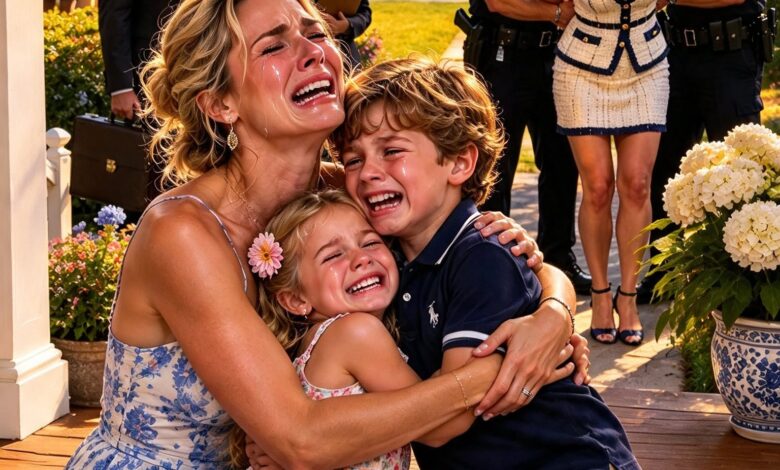
Chapter 1: The Bubblegum Crown
I was kneeling on the cold, hexagonal tiles of our guest bathroom, the air thick and humid, suffused with the cloying, artificial sweetness of strawberry bubblegum shampoo. I was busy rinsing a mountain of suds from the hair of my six-year-old daughter, Maya. She was giggling uncontrollably, her tiny hands working the foam into a precarious, bubbly crown atop her head. It was a perfectly mundane Tuesday evening, a snapshot of ordinary chaos that I would soon crave with a desperation that bordered on madness.
Then, the phone buzzed against the marble vanity.
The screen flashed the name of my older sister, Clare. I wiped my dripping hands on a monogrammed towel, leaving a damp patch on the terrycloth, and swiped to answer. I expected a casual check-in, perhaps a question about our upcoming family barbecue or a complaint about her husband’s work schedule.
“I’m so incredibly sorry,” Clare whispered. Her voice was not her own; it was trembling, brittle, stretched so thin it sounded like tearing parchment. “I had to do what was right for the kids. CPS will be there tomorrow morning.”
My brow furrowed. I switched the phone to my other ear, trying to block out the sound of the running bathwater. “Clare? What on earth are you talking about?”
“I just couldn’t watch it anymore,” she choked out, a bizarre theatricality to her sob.
And then, a sharp, hollow click. The line went dead.
I stood frozen, staring at the darkened screen of my phone as lukewarm water dripped from my elbow, pooling onto the plush bathmat beneath my knees. A sudden, violent knot of dread tightened in my stomach—a visceral coldness utterly at odds with the warm, steamy confines of the bathroom. I dialed her back immediately. It went straight to voicemail. I dialed again. Nothing.
She’s having a breakdown, I told myself, trying to regulate my sudden, shallow breathing. She and Mark must have had a terrible fight. She’s confused.
I forced myself to smile as I finished rinsing Maya’s hair, wrapping her in a hooded towel that made her look like a tiny, pink dinosaur. I went through the motions of our nightly routine, tucking Maya and my nine-year-old son, Devon, into their beds. I read them stories, kissed their foreheads, and turned on their nightlights. But once their doors were closed, the facade crumbled. I paced the length of our hardwood living room floor, wearing a track in the rug, drinking black coffee until my hands shook, waiting for the sunrise.
The knock came precisely at 7:00 A.M.
It was not a polite, neighborly tap. It was the heavy, authoritative pounding of law enforcement, the kind of sound that vibrates through the floorboards and rattles your teeth.
When I swung the heavy oak door open, the reality I had known my entire life fractured into a million jagged pieces. A Child Protective Services investigator stood on my porch, his face a mask of bureaucratic indifference, flanked by two uniformed police officers. One of the officers gripped a crisp, white court order in his thick hands.
“We received a highly credible report of severe physical and emotional abuse,” the investigator stated. He didn’t introduce himself. His voice was devoid of any human warmth, flat and mechanical. “We have an emergency order to examine your children and the premises immediately.”
“This is an insane mistake,” I stammered, my maternal instincts overriding my logic as I physically blocked the doorway, spreading my arms across the frame. “My sister called me last night, she’s not well, she’s confused, she—”
“Step aside, ma’am,” the taller officer interrupted. His hand drifted casually, yet purposefully, to rest on the heavy black belt near his holster. “Do not make us remove you.”
I stepped back, the breath knocked out of me. They swarmed into my sanctuary like an invading army. The violation was absolute. They yanked open kitchen drawers, photographed the inside of my refrigerator, and literally ran a thermometer under the bathroom tap to check the water temperature. Then, they executed the most terrifying maneuver of all: they divided and conquered.
They ushered a bewildered Maya into her pink bedroom and marched Devon into the kitchen. I was ordered to stand in the hallway. I stood there, paralyzed, straining my ears to hear through the walls, my heart hammering against my ribcage like a trapped, panicked bird.
Ten agonizing minutes later, the bedroom door opened. Maya stumbled out, her face red and smeared with tears, clutching her frayed, stuffed rabbit to her chest with a white-knuckled grip. Devon followed from the kitchen. My brave, stoic boy looked pale and utterly terrified, his wide eyes darting frantically between me and the massive officers.
“We found a significant contusion on Devon’s upper bicep,” the investigator announced loudly, snapping his notebook shut with a crack that echoed in the quiet house. “Furthermore, the youngest child exhibits clear, undeniable signs of trauma and anxiety in your presence.”
“Devon plays competitive travel soccer!” I shrieked, the panic now a physical obstruction in my throat. “He’s a center midfielder! He gets bruised every single week fighting for headers and tackles. Call his coach! And Maya is crying because giant strangers with guns are interrogating her in her pajamas!”
They did not care about context. They did not care about explanations. The machine had been turned on, and it was going to grind us down.
“We are executing the emergency removal of the children for their immediate safety,” the investigator droned, citing protocol. “They will be placed in emergency foster care pending a preliminary hearing.”
“No!” I lunged forward, desperate to grab Maya’s tiny, outstretched hand.
“Ma’am! Step back now or you will be placed in handcuffs!” The officer stepped squarely between us, his tactical vest bumping hard against my chest, physically driving me backward.
I froze. The terrifying calculus of the situation washed over me. If I fought them, I would be arrested for assaulting an officer. I would go to jail, and my children would be thrust into the system completely alone. I was forced to watch, paralyzed inside a waking nightmare, as they corralled my screaming, sobbing children toward the front door.
“Mommy! Mommy, no! Please!” Maya shrieked, her voice tearing at my soul.
Devon didn’t make a single sound, but as he looked back at me, tears were streaming down his cheeks in silent, devastating rivers.
They loaded them into the back of an unmarked, sterile white van. The investigator shoved a thick stack of stapled paperwork into my trembling hands.
“Do not attempt to contact your children. We will conduct a full investigation. If these allegations are substantiated, you are looking at up to twenty years in state prison. Your emergency hearing is on the docket in five days.”
The van’s tires chirped against the asphalt as it drove away, taking my entire universe with it. I stood on the sidewalk barefoot, the crisp morning air biting at my skin, watching the taillights disappear around the corner of Elm Street.
I walked back inside. The silence of the empty house was deafening, far louder and far more violent than the screaming had been just moments before.
Best Stories
Believe in Miracles
•
0 Comment
Chapter 2: The Stolen Life
The first thing I did was practically tear the paperwork apart looking for a phone number. I found the contact for the county’s emergency placement division and dialed, my fingers slipping on the glass screen of my phone. A woman answered, her tone bored and administrative.
“Please,” I begged, my voice breaking. I didn’t care about dignity. I cared about survival. “I just want to hear their voices. Just for thirty seconds. Please, just tell them their mother loves them and that this is a mistake.”
“A no-contact order means exactly that, ma’am—no contact,” she replied sharply, the annoyance palpable through the receiver. “Any violation of this order will result in immediate criminal charges and will severely damage your custodial case.”
Click.
I threw the phone onto the couch. I couldn’t just sit in this mausoleum. I grabbed my car keys and drove like a maniac to Maya’s daycare center, desperate for anything—attendance logs, daily report cards, finger paintings—anything that proved she was a thriving, joyous, profoundly loved child.
Rita, the daycare director who had hugged me just yesterday, met me at the reinforced glass doors. She didn’t unlock them. She stood with her arms tightly crossed over her chest, refusing to meet my frantic gaze.
“The state instructed us not to have any dialogue with you,” Rita said through the intercom, her voice distorted and cold. “Furthermore, your sister was already here an hour ago to collect Maya’s belongings. She presented the paperwork. She’s been granted temporary guardianship.”
My knees turned to water. I had to lean against the brick facade of the building to keep from collapsing on the pavement. “Temporary what? The hearing isn’t for five goddamn days, Rita!”
“Emergency placement with an approved family member,” she recited, looking over my shoulder at the parking lot. “It’s standard operating procedure when a blood relative steps forward and passes the background checks. I’m sorry, but if you don’t leave the premises, I have to call security.”
Clare.
Clare had them.
I practically flew back to my house, running a red light in my frenzy. My mind was spinning, piecing together a terrifying puzzle. If Clare had orchestrated this, I needed an alibi. I needed proof of my reality. I sprinted into my home office to check our comprehensive internal security camera system. I had installed it after my husband passed away, paranoid about break-ins. It held six months of continuous, cloud-backed footage, but the master files were downloaded locally. It contained thousands of hours of irrefutable proof: family dinners full of laughter, patient homework sessions at the kitchen island, animated bedtime stories, and raucous tickle fights on the rug. It was the undeniable documentary of a loving, unbroken home.
I dropped to my knees and reached behind the heavy oak desk for the external hard drive bay.
My hand met empty air.
I scrambled under the desk, shining my phone’s flashlight into the dusty shadows. The primary drive was gone. And it hadn’t just been unplugged. The thick power and data cables had been severed cleanly, snipped with wire cutters.
Clare had a spare key. She had offered to water my indoor plants last week while I was in Chicago for a real estate conference. She had been inside my house alone. She had methodically stolen the only objective witness that could save me from her lies.
I dialed 911. “My sister broke into my home!” I screamed into the receiver, pacing the office like a caged animal. “She destroyed property! She stole digital evidence! She’s framing me to steal my children!”
The patrol officer who arrived an hour later looked at me as if I were a nuisance. He leaned against the doorframe of my office, lazily scribbling on a pocket notepad without once making eye contact.
“Ma’am, based on the documentation logged with the county, your sister currently holds temporary emergency custody of your children. Under the law, she is permitted to collect the children’s belongings from their primary residence to ease their transition.”
“She didn’t take their clothes! She took a hard drive with video footage!” I yelled, pointing wildly at the severed black cables dangling from the desk.
“If you firmly believe a specific electronic item was stolen, you can file a formal property theft report,” he sighed, clicking his pen closed. “But I have to warn you, non-violent theft investigations take weeks, sometimes months, to get assigned to a detective.”
“I don’t have weeks! My custody hearing is in five days! They are going to take my kids away forever!”
“Then I highly suggest you stop yelling at me and start speaking with a qualified family law attorney,” he said, turning on his heel and walking out of my house.
Because I couldn’t access my frozen bank accounts—a wonderful side effect of the ongoing investigation—I was assigned a public defender. When I finally got Mr. Hayes on the phone that evening and frantically vomited the details of the severed cables, Clare’s long-standing jealousy, and her pathological lies, he let out a long, wheezing sigh. It was the sound of a man drowning in paperwork.
“Listen to me very carefully,” Hayes said, his voice a monotone drone. “I currently have sixty-three active, high-priority cases on my desk. Here is the reality of your situation: CPS found physical bruising on the boy. They have multiple sworn witness statements—neighbors that your sister apparently interviewed—who support the claims of a hostile environment. Meanwhile, your sister possesses a spotless criminal record, a high-income stable marriage, and she miraculously passed a rigorous emergency home study in under forty-eight hours. Do you know what that means?”
“It means she planned this!” I cried out. “She started the process months ago behind my back!”
“Exactly. And do you have a single shred of tangible, admissible proof to back up that theory?”
I looked at the empty space beneath my desk. “No.”
“I will do my absolute best to represent you,” Hayes said, though I could hear him typing on his keyboard, already distracted. “But the state’s evidence is overwhelming. You need to mentally and emotionally prepare yourself for the very real possibility of losing permanent custody of your children on Tuesday.”
Best Stories
Believe in Miracles
•
0 Comment
Chapter 3: The Echoes of a Dead House
For the next four days, I existed in a localized version of hell. My home, once a sanctuary of warmth and chaotic joy, transformed into a museum of my failures. I stopped eating. I stopped sleeping. I spent hours sitting on the floor of Devon’s empty bedroom, clutching one of his grass-stained soccer cleats to my chest, breathing in the scent of mud and leather just to convince myself he was real.
I became a telephonic phantom, calling everyone who had ever interacted with our family. I phoned Maya’s pediatrician, Dr. Aris. I called Devon’s soccer coach, Hudson. I even reached out to my late husband’s estranged family on the east coast.
They were polite. They expressed muted sympathy. But I could hear the invisible wall slamming down the moment I mentioned Child Protective Services. The accusation of child abuse is a toxic, indelible stain. It doesn’t wash off, even if you are entirely innocent. People who had eaten at my dinner table, people who had trusted me to carpool their own children, suddenly hesitated. Their voices grew guarded, their sentences clipped.
By day four, I managed to scrape together enough cash from a hidden emergency envelope to hire a private investigator, a gruff ex-cop named Miller.
“Find the digital footprint,” I begged him across the scratched veneer of his desk. “Find her search histories, trace her texts. Pull the neighborhood security cameras to prove she came into my house while I was gone. Prove it.”
Miller took my cash and promised results. He called me back exactly three hours later.
“Come pick up your money,” he said, his voice tight. “I can’t touch this case.”
“What? Why?”
“Your sister’s attorney—a very expensive shark, by the way—contacted my office twenty minutes ago. He informed me that if I attempt to interfere with, or independently investigate, an active CPS case involving minors, he will petition the state board to strip my private investigator’s license. I’ve got a mortgage, lady. I’m sorry. You’re on your own.”
The night before the hearing, a violent thunderstorm rolled through the valley. Lightning illuminated the empty corners of my living room in harsh, strobe-like flashes. I sat on the rug, surrounded by scattered photographs of my children. I had tried everything. I had fought the bureaucracy, the police, and the stigma, and I had categorically failed.
Clare had checkmated me before I had even realized we were sitting at a chessboard.
She had always been the golden child, the one who married wealth, the one who maintained the perfect aesthetic. But she was barren. Ten years of IVF, holistic treatments, and surrogate failures had hollowed her out, leaving behind a bitter, calculating shell. When my husband died of a sudden aneurysm three years ago, Clare had swooped in, playing the tragic, supportive aunt. I thought she was helping me grieve. I didn’t realize she was auditioning for the role of my children’s new mother.
As the rain lashed against the windows, I finally allowed myself to weep. It was a guttural, ugly sound that tore at my throat. Tomorrow, a man in a black robe was going to strike a wooden mallet against a desk, and my children would legally become hers.
Morning broke, gray and oppressive. The county courthouse smelled of industrial floor wax, stale coffee, and the metallic tang of desperate sweat.
I walked into Courtroom 4B and took my seat at the defendant’s table next to Mr. Hayes. His ill-fitting gray suit was wrinkled, and he was frantically flipping through my file, licking his thumb to turn pages he clearly hadn’t memorized.
Across the wide center aisle, seated at the petitioner’s table, was Clare. She sat next to her wealthy husband, Mark, who looked deeply uncomfortable in his tailored navy suit. Clare, however, was putting on the performance of a lifetime. She wore a modest, pale blue dress. Her makeup was expertly applied to make her look pale and exhausted. She dabbed at her dry eyes with a monogrammed tissue, playing the role of the heartbroken, reluctant savior to absolute perfection.
When our eyes met across the room, the facade slipped for a fraction of a second. A cold, triumphant smirk ghosted across her lips.
Judge Kramer, an imposing man with a shock of white hair and a face carved from granite, called the emergency custody hearing to order precisely at 10:00 A.M.
The state caseworker stood and presented the file. It was a staggering masterpiece of fiction. There were high-definition, zoomed-in photographs of Devon’s soccer bruises, aggressively lit and framed to look like defensive wounds from a beating. There was a psychological evaluation from a school guidance counselor—a woman Clare had manipulated over the phone for weeks, feeding her lies about my “erratic” behavior since my husband’s death. There were signed affidavits from my neighbors, stating they heard “frequent, violent shouting” coming from my home—which was unequivocally us screaming in triumph at the television during Sunday football games.
Then, the prosecution called Clare to the stand.
She ascended the steps to the witness box, trembling perfectly. She swore on the Bible. And then, she wept softly into the microphone.
“I love those children as fiercely as if they were born from my own body,” Clare testified, her voice cracking with manufactured grief. “I tried to help my sister. Lord knows, I tried to step in, to offer her a break, to get her psychiatric help. But I simply cannot stand by and watch those innocent babies suffer in that house of horrors anymore. My husband and I have a wing of our home ready for them. A stable, two-parent household. They deserve to be safe, Your Honor. They deserve a real mother.”
Judge Kramer’s expression hardened. He turned his imposing gaze down upon me, his eyes filled with contempt.
“Does the defense have any substantive evidence—not conjecture, but physical evidence—contradicting these severe allegations?” the judge boomed.
Hayes stood up slowly, buttoning his jacket with a shaking hand. “Your Honor, we can reasonably explain the contusions. The boy plays a highly physical brand of competitive soccer…”
“Counselor, I did not ask for a theory,” Judge Kramer interrupted, his voice like a whip crack. “I asked if you possess tangible evidence. Medical records proving a sporting injury? Video footage of the home environment? Anything?”
Hayes looked down at the table. “No, Your Honor. We do not.”
The silence that blanketed the courtroom was suffocating. It was the exact sound of my life ending, of the trap snapping shut forever. Judge Kramer raised his gavel, taking a breath to deliver the ruling that would sever my maternal rights.
Suddenly, the heavy oak doors at the back of the courtroom exploded open with a deafening BANG.
Best Stories
Believe in Miracles
•
0 Comment
Chapter 4: The Digital Confession
The entire courtroom whipped around. Standing in the doorway was Elena, my late husband’s fiercely loyal best friend. Her hair was wild, plastered to her forehead with rain, and her chest was heaving as she fought for breath. Clutched tightly against her soaking wet trench coat was a sleek, silver laptop.
“Your Honor!” Elena gasped, her voice echoing off the high, paneled ceilings. “Stop! I have the proof! She didn’t do this!”
Judge Kramer scowled, his gavel hovering in mid-air. “Ma’am! You cannot simply barge into a closed family court proceeding. Bailiffs, remove this woman immediately!”
Two heavy-set deputies started moving down the aisle, their hands reaching for their cuffs.
“I found Clare’s backup laptop!” Elena screamed, sidestepping the first deputy and sprinting down the center aisle. “I have her entire search history! I have the unedited videos! I have everything she used to frame her!”
The judge paused, his eyes narrowing. He looked past Elena, straight at the witness stand. I followed his gaze. Clare’s face had completely drained of color. The sorrowful, angelic mask had slipped entirely, replaced by a look of sheer, unadulterated terror. Her hands were gripping the wooden railing of the witness box so hard her knuckles were bone-white.
Judge Kramer waved the bailiffs off with a flick of his wrist. “Approach the bench, ma’am. And this had better be relevant, or you will be spending the week in a county cell for contempt.”
Elena didn’t hesitate. She marched past my table, giving my shoulder a bruising, reassuring squeeze, and approached the clerk’s desk. She opened the silver laptop, her fingers flying across the trackpad as she plugged it into the courtroom’s presentation HDMI cable. The massive digital screen on the wall behind the judge flickered to life.
“Look at the timestamps, Your Honor,” Elena said, her voice ringing with righteous fury.
There it was, projected in ten-foot-tall letters for the court, the stenographer, and Mark to see. Four months ago.
Google Search: “How to win a CPS emergency removal case against a biological sibling.”Google Search: “How to photograph normal child bruises to mimic physical abuse.”Google Search: “Establishing temporary guardianship if single mother is deemed psychologically unfit.”
A collective gasp rippled through the gallery. Mark slowly stood up from his chair, staring at the screen as if it were written in an alien language.
“That’s just the prologue,” Elena said grimly. She clicked on a hidden desktop folder aggressively titled, “The Plan.”
It was a masterclass in sociopathic premeditation. The folder contained word documents with drafted templates for fake text messages she had planned to send herself from my spoofed phone number. It contained a meticulous, color-coded calendar outlining exactly when to plant seeds of doubt with the school counselor.
And then, Elena clicked on a video file.
The courtroom speakers crackled to life. It was a selfie video of Clare, holding her phone in my guest bathroom mirror, practicing her tearful testimony. But then, the camera angle swung around.
It showed Maya and Devon sitting on my living room couch. They were wearing the clothes they had on the day I went to Chicago. They looked deeply confused and uncomfortable.
Clare’s voice echoed through the courtroom, dripping with saccharine, poisonous manipulation.
“Listen to me, sweeties. Your mommy is very sick in her head. She doesn’t want you anymore. She told Auntie Clare she’s so tired of taking care of you and she wants to be alone. That’s why you have to come live with me and Uncle Mark. But the police won’t let you unless you help me. If you tell the nice police man that mommy hit you and makes you scared, we can be a real family. Do you understand? It’s a secret game to save yourselves.”
On the screen, Maya began to cry. Devon just stared at the camera, his young face hardening into a mask of betrayal.
The courtroom went dead, terrifyingly silent. You could hear the low hum of the HVAC system and the frantic, shallow breaths coming from the witness stand.
Judge Kramer stared at the frozen frame of the video for a long, heavy minute. Then, he slowly swiveled his massive leather chair to face Clare. The contempt in his eyes was absolute.
“Mrs. Wilson,” the judge rumbled, his voice dangerously low. “Did you willfully fabricate these allegations, tamper with evidence, and emotionally coerce minors in a deliberate plot to fraudulently gain custody of your sister’s children?”
Clare’s meticulously constructed reality shattered. The sophisticated, wealthy aunt dissolved into a desperate, feral creature right before our eyes.
“I can’t have children!” she shrieked, a guttural, agonizing sound that seemed to tear from her very soul. She pointed a trembling, manic finger at me. “I subjected my body to hell for ten years! Ten years of needles and failure! She has two perfect children, and she doesn’t even appreciate them! She feeds them frozen dinners! She’s drowning without her husband! They love me! I have the money! I would be a better mother!”
The courtroom exploded into chaos. The stenographer’s hands flew across her machine. Mark, Clare’s husband, stumbled backward into his chair, covering his mouth with his hands, looking at his wife of twelve years as if a demon had just unzipped her skin.
“Order!” Judge Kramer barked, slamming his gavel with a force that sounded like a gunshot. The room snapped back to silence. He pointed his gavel directly at Clare. “Bailiffs. Take Mrs. Clare Wilson into immediate custody pending a grand jury investigation for felony perjury, filing false police reports, evidence tampering, and severe child endangerment.”
The two massive deputies moved in instantly. Clare didn’t fight them. She collapsed in on herself, weeping hysterically into her manicured hands as the cold steel handcuffs were ratcheted tightly around her wrists.
I sat there, glued to my chair. I watched my flesh and blood—the woman who had shared a bedroom with me as a child, the woman who had held my hand as they lowered my husband’s casket into the earth—being hauled away in chains. I expected to feel triumphant. Instead, a hollow, nauseating mix of relief and profound tragedy washed over me.
Judge Kramer turned his attention back to me. His stern features softened, but the heavy mantle of the law remained.
“Ma’am, while this newly presented evidence radically changes the landscape and trajectory of this case,” he said slowly, “Child Protective Services protocol is immutable. The children have been deeply traumatized and manipulated. The state requires a full, independent psychological re-evaluation of the home environment before full custodial rights can be formally restored.”
My heart plummeted into my stomach. “Your Honor,” I pleaded, standing up, my voice shaking. “She just confessed on tape! They are my kids. Please, let me take them home today.”
“I sympathize with you, I truly do,” Judge Kramer replied, not unkindly. “But the children have been absorbed into the system. We must process the trauma they have just endured and ensure your home is equipped to handle their recovery. I am scheduling an emergency follow-up hearing for three days from now.”
Three more days in the system.
“However,” the judge added, signing a document with a flourish, “I am immediately issuing a temporary order allowing supervised visitation, commencing tomorrow morning. You are granted two hours a day.”
Two hours. It felt like a slap in the face, an insult to my motherhood, but it was a frayed rope thrown to a drowning woman. I would take it.
Best Stories
Believe in Miracles
•
0 Comment
Chapter 5: The Visitation Room and The Shark
As I stumbled out of the heavy oak doors of the courtroom, Elena tackled me into a desperate, crushing hug. She held me so tightly my ribs ached, her tears soaking through my blouse.
“How did you find it?” I gasped against her shoulder. “How did you know?”
“I went to drop off your husband’s old collection of vinyl records at Clare’s house this morning,” Elena explained, wiping her mascara-stained cheeks. “Mark was at work, and the front door was slightly ajar. I walked into the kitchen, and her backup laptop was just sitting there, glowing on the marble island. I don’t know why, but I just… I had a gut feeling. I guessed her password. It was Devon and Maya’s birthdays. When I saw the desktop, I just grabbed it and ran.”
“You saved our lives,” I told her, the weight of my gratitude crushing me.
Mr. Hayes, the public defender, walked up behind us. He looked exhausted, but there was a new respect in his eyes. He handed me a crisp, heavy-stock business card.
“You need a real lawyer now,” Hayes said quietly, looking over his shoulder. “My job is done, but the state is still going to drag its feet. You need someone to force their hand. To sue the county. To get those kids back permanently, and to make sure your sister never breathes near them again.” He tapped the card. “Call Clive Dougherty. He’s the biggest shark in the state.”
I didn’t go home. I drove straight to Clive’s downtown office.
Clive was in his late sixties, with razor-sharp features, silver hair slicked back, and a bespoke charcoal suit that screamed intimidation. He sat behind a massive mahogany desk, silently watching the video Elena had recovered. When it finished, his jaw tightened, the muscles ticking in his cheek.
“We are taking the case,” Clive said, his voice a gravelly baritone. “But listen to me closely. Proving her lies isn’t enough for the state machinery. CPS never, ever likes to admit they were fooled. They will look for any excuse to justify their initial removal. We don’t just need to prove she lied; we need to build a fortress of positive evidence around your character. We are going to bury them in proof of your fitness as a mother.”
We spent the next twenty-four hours building an arsenal. We subpoenaed five years of pediatric medical records showing perfect health and zero missed appointments. We secured impassioned, sworn affidavits from Hudson the soccer coach, from my neighbors, and from Rita the daycare director, who was profusely apologetic after learning the truth.
The next morning, armed with hope and a racing heart, I arrived at the county CPS visitation center.
The environment was clinically depressing. It was a sterile, windowless room painted a nauseating beige, scattered with a few broken plastic toys. The air smelled aggressively of industrial bleach and institutional despair.
When the heavy security door buzzed and opened, Maya sprinted into the room. I dropped to my knees, bracing myself, and she slammed into my chest with the force of a tiny hurricane. She wrapped her arms around my neck, sobbing hysterically.
“Mommy! Mommy, I want to go home!”
But Devon… Devon didn’t run.
He stood frozen in the doorway. He looked drastically older than his nine years. His shoulders were slumped, his jaw set, and his eyes were guarded, shielded by a thick wall of anger and confusion.
“Come here, my brave boy,” I choked out, extending my hand toward him.
He walked over with agonizing slowness. I pulled him into the embrace, burying my face in their hair, inhaling the lingering scent of the foster home’s cheap soap, trying to anchor myself to the reality that they were in my arms.
Devon pulled back slightly, his dark eyes locking onto mine.
“Why did you let them take us?” he whispered, his voice trembling with betrayal.
The question hit me with the physical force of a sledgehammer to the sternum.
“I didn’t let them, Dev,” I pleaded, tears streaming down my face. “I fought them. They threatened to put me in jail if I didn’t let them take you. I promise you, I have been fighting every single second to get you back.”
“Aunt Clare said you were tired of us,” he said flatly, parroting the poison he had been force-fed. “She said you wanted to be alone because dad died. She said we were too much work.”
“Look at me,” I said fiercely, cupping his face in my hands, forcing him to hold my gaze. “Aunt Clare is a very sick, very broken woman. She told you horrible lies because she is empty inside and she wanted to steal you for herself. I have never, ever wanted to be without you. Not for one second of my life. You are my air, Devon.”
We sat on the hard linoleum floor. I tried to engage them in a puzzle, to conjure a sense of normalcy, but the air in the room was thick with unhealed trauma. In the corner, a state social worker sat with a clipboard, her pen scratching loudly in the silence, judging my every movement, every sigh, every tear. Every time I glanced at her, a hot, violent rage flared in my chest. But I swallowed it down like broken glass. I had to be the picture of perfect, unbothered maternal grace.
When the excruciating two hours were up, the buzzer sounded. Maya screamed, a primal sound of terror. The social worker had to physically peel her fingers off my sweater. Devon simply shut down. His face went entirely blank, a survival mechanism kicking in, as he turned and walked out the door without looking back.
I walked out to the parking lot, got into my car, locked the doors, and screamed until my throat tasted like copper. Then, I wiped my face, put the car in drive, and headed to the police station.
I sat down with a detective and formally signed the criminal complaint pressing charges against my own sister for burglary and grand theft. A small part of my brain screamed that I was betraying my blood. But then the image of Devon’s blank, traumatized face in that beige room flared in my mind, burning away any lingering familial guilt. I signed the papers with a steady hand. It was total war.
Best Stories
Believe in Miracles
•
0 Comment
Chapter 6: The Long Road Home
The following weeks blurred into an exhausting marathon of bureaucracy, therapy, and legal maneuvering.
Clive filed motion after aggressive motion, drowning the county counsel in paperwork. Judge Kramer, recognizing the severity of the state’s blunder, ordered an independent psychological evaluation for our entire family, bypassing the compromised county system.
I sat in a plush armchair across from Martha Pike, a renowned clinical specialist in child trauma and parental alienation. I didn’t feed her the polished, perfect narrative the CPS workers wanted. I fed her the raw truth. I told her about the soul-crushing exhaustion of being a widowed, single mother. I admitted to burning dinners, to occasionally losing my temper over math homework, to crying in the shower where the kids couldn’t hear me.
“Perfection is an illusion created by liars,” Martha told me gently, pausing her note-taking. “The goal of a family isn’t perfection; it is connection, resilience, and unconditional safety. And after reviewing the tapes and interviewing your children, it is blindingly clear you have built that foundation. They are adrift without you.”
Slowly, agonizingly, the tide began to turn.
The county assigned a new caseworker, a seasoned, weary man named Quentyn. Unlike the first investigator, Quentyn actually looked at the evidence. He sat in my living room, drank my coffee, and looked through years of photo albums. He watched the videos of Devon’s soccer matches, seeing the brutal tackles that caused the infamous bruises.
“We failed you,” Quentyn admitted quietly during his final home visit, staring down at his coffee mug. “The system operates on panic and liability. When your sister presented a seemingly perfect alternative, we moved too fast and ignored the context. I am filing my report this afternoon. I am recommending immediate and total reunification.”
The final custody hearing took place two weeks later.
The atmosphere in Courtroom 4B felt entirely different. The oppressive, terrifying weight was gone, replaced by a tense anticipation. Clare was conspicuously absent; she was currently sitting in a secure psychiatric facility on a judge’s hold, awaiting her criminal trial.
Judge Kramer adjusted his reading glasses and read Martha Pike’s final psychological report into the official record.
“The minor children exhibit acute signs of severe emotional manipulation and trauma inflicted by the maternal aunt,” Kramer read, his voice echoing in the quiet room. “However, their core attachment to their biological mother remains secure, deeply loving, and is absolutely essential for their psychological recovery.”
He lowered the document and looked directly at me. The harshness in his eyes was gone, replaced by a solemn respect.
“It is the ruling of this court that full, unencumbered legal and physical custody be restored to the mother, effective this very second,” Judge Kramer declared, raising his gavel. “Furthermore, I am issuing a permanent, lifetime restraining order against Clare Wilson. She is not to come within five hundred yards of you or your children, ever again.”
The gavel struck the wood.
I inhaled a shuddering breath, feeling oxygen reach the bottom of my lungs for the first time in a month.
The drive home from the county facility felt like floating through a dream. The children’s car seats were back where they belonged. The chatter in the backseat was hesitant, fragile, but it was real.
When I unlocked the front door and we walked into the house, they reacted as if they were entering a museum of a past life. Maya clung to my thigh, refusing to let go, eyeing the shadows in the hallway. Devon didn’t speak. He walked a slow perimeter of the entire house, checking the locks on the windows, checking behind the shower curtains, searching for the threat he knew could always return.
“Are we staying this time?” Maya asked, staring at her basket of toys as if they might turn to smoke and blow away.
“Forever,” I promised, kneeling down to kiss her forehead.
But the damage inflicted by Clare was not a superficial wound; it was a bone-deep fracture. That first night back, sleep was impossible. Maya woke up screaming from night terrors every hour. Devon refused to sleep in his bed, sitting cross-legged by his bedroom door, keeping watch like a tiny, terrified sentry. I eventually dragged all the mattresses into the living room, building a massive “camp,” and we slept in a tangled pile of blankets on the floor for the next week.
Recovery was not a straight, upward trajectory. It was a jagged, bloody climb.
Ten days after they came home, Devon exploded. He was struggling with a complex fraction on his math homework. Out of nowhere, he hurled his heavy textbook across the kitchen, shattering a glass on the counter.
“You’re useless!” he screamed at me, his face red and contorted with an ugly, inherited rage. “You couldn’t even stop them! You couldn’t protect us! You just let them take me!”
Every instinct I had urged me to yell back, to discipline the disrespect. But I remembered Martha’s advice. He isn’t angry at you. He is angry at his powerlessness. He is testing to see if your love is conditional.
I didn’t raise my voice. I walked over the shattered glass, sat down on the kitchen floor right next to him, and let him scream. He battered his small fists against my chest, hurling insults, crying until he literally ran out of oxygen. When his arms dropped in exhaustion, I pulled him tight against me, rocking him back and forth on the tiles.
“It is absolutely okay to be furious,” I whispered into his hair. “I am so mad too, Devon. I am so sorry I couldn’t stop them that day. But I will never stop fighting for you. Never.”
We began intensive family therapy. We created a vocabulary for our trauma, referring to that terrible month as the “Time of Lies.” Slowly, methodically, we detoxed the poison Clare had injected into their minds.
Best Stories
Believe in Miracles
•
0 Comment
A month later, Clive called me while I was grocery shopping.
“The District Attorney is offering your sister a plea deal,” he announced, the satisfaction evident in his tone. “She pleads guilty to felony child endangerment and filing false reports. She gets five years of highly supervised probation, mandatory inpatient psychiatric treatment for two years, and she carries a felony record for the rest of her life. No state prison time, provided she stays perfectly compliant.”
“I’ll take it,” I said instantly, gripping the handle of the shopping cart. “I refuse to put Devon and Maya on a witness stand to testify in a trial. I want this over.”
I attended her sentencing hearing alone. Clare looked incredibly small, heavily medicated, and utterly broken. Her hair was dull, her designer clothes hung loosely on her frail frame. She read a scripted apology to the court, but she couldn’t summon the courage to look at me in the gallery. The judge accepted the plea.
As the bailiffs led her away to the psychiatric transport, her husband, Mark—who had already filed for a highly publicized divorce—intercepted me in the marble hallway. He looked like he had aged a decade.
“I didn’t see it,” Mark pleaded, his voice hollow, his eyes begging for absolution. “I swear to God, I didn’t see the monster she was becoming behind closed doors.”
“Neither did I, Mark,” I replied coldly, zipping my jacket. “And that is the scariest part of all.”
Six months passed. The snow melted, giving way to a vibrant, aggressively green spring.
The rhythm of our lives returned, but it was a new, altered rhythm. We lived with profound intention. Friday nights were sacrosanct movie nights, phones turned off. Saturday mornings were dedicated to the soccer pitch—I had aggressively volunteered to become the assistant coach, simply so I never had to watch Devon from the sidelines again. Sundays, we visited the quiet, oak-shaded park where we had scattered my husband’s ashes, telling him stories of how we had survived the fire.
One lazy Tuesday afternoon, I received a certified letter from Clare’s defense attorney, politely requesting if she could send birthday cards to the children from her facility.
I didn’t make the decision alone. I sat the kids down at the kitchen table and asked them.
Devon shrugged, his eyes focused on his drawing. “I guess she can send a piece of paper if she wants. But I don’t ever want to see her face again.”
Maya didn’t look up from her coloring book. “I don’t want a card,” she stated with fierce, uncharacteristic finality. “She’s a mean lady who tells lies.”
I respected their boundaries. I took out a pen and wrote across the attorney’s letter in bold, black ink: NO CONTACT. DO NOT EVER ASK AGAIN.
It was the most difficult thing I had ever done in my life, permanently severing the limb of my only sister. But I wasn’t a sister first anymore. I was a mother. The limb was infected, and I had amputated it to save the body.
Winter arrived with a bitter chill. Devon’s soccer team had miraculously battled their way to the regional championship. It was a freezing, overcast December morning. The game was tied, the clock ticking down the final sixty seconds. Devon received a desperate pass at midfield. He aggressively dribbled past two massive defenders, took a vicious shoulder check that knocked him to the freezing mud, but he popped right back up, spinning on his heel, and sent a blistering shot into the top corner of the net for the winning goal.
The referee blew the final whistle. The parents erupted.
Devon didn’t run to celebrate with his teammates. He turned, scanned the sidelines, and sprinted straight toward me. I dropped my clipboard, dropped to one knee, and caught him as he leaped into my arms, lifting him up in front of the cheering crowd.
“We did it!” he yelled, his face smeared with mud and joy.
“You did it, my brave boy,” I laughed, tears freezing on my cheeks.
Later that night, the house was warm, smelling of pine needles and hot chocolate. As I tucked Maya into her bed, pulling the thick duvet up to her chin, she reached out and grabbed my hand.
“Mommy?” she whispered, her eyes heavy with sleep.
“Yeah, my little bug?”
“I love you to the moon and back infinity times.”
My breath hitched in my throat. I felt a tear slip free. That was the exact phrase my husband used to whisper to her when she was a baby.
“I love you to the moon and back infinity times,” I whispered back, kissing her soft cheek.
I walked out to the living room. The Christmas tree was lit, casting a warm, golden glow across the hardwood floors. The house was quiet, but it was no longer empty. It was vibrating with safety. It was full of hard-won peace.
We were permanently scarred. I checked the deadbolts three times a night now. Devon still flinched at the sound of police sirens. Maya still required a text message if I was going to be five minutes late to daycare pickup. The trauma would always be a passenger in our lives.
But we were together. We had been dragged through the absolute fires of hell, navigated a system designed to break us, and we had come out the other side, holding hands, our bond forged in titanium. As I sat on the couch, watching the colorful lights reflect in the dark windowpane, I knew with absolute, fierce certainty that no one, and nothing, would ever take this away from me again.
The system had spectacularly failed us. But love—vicious, stubborn, terrifyingly protective love—had won the war.
And that was finally enough.