
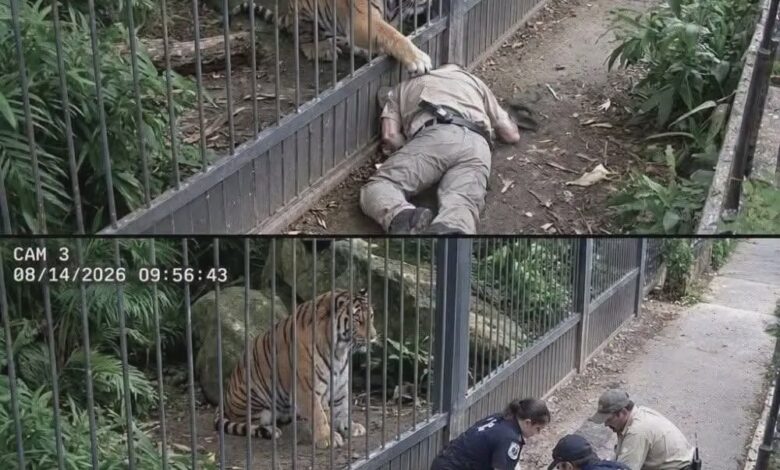
Tiger Approaches Caretaker After He Collapses
Editorial note: The following article expands upon the original account provided. The specific incident involving Julian and Khan has not been independently verified. The additional discussion explores animal behavior, human-animal relationships, wildlife conservation, and the importance of emergency preparedness without presenting invented details as established facts.
At an animal refuge, mornings usually follow a familiar rhythm. Before visitors arrive and the activities of the day begin, caretakers are already moving through the grounds, inspecting enclosures, checking equipment, preparing food, and observing the animals entrusted to their protection.
For experienced animal caretakers, these early hours represent more than a collection of routine responsibilities. They provide an opportunity to understand the animals, recognize changes in their behavior, and ensure that their surroundings remain secure.
Julian, a veteran caretaker, was reportedly carrying out one of these familiar morning inspections when something unexpected happened.
He was walking along the perimeter track beside a tiger habitat, following a route that had become part of his daily responsibilities. Nothing about the morning appeared particularly extraordinary.
Inside the enclosure rested Khan, a powerful tiger with whom Julian shared a long history.
According to the original account, Julian had helped raise Khan by hand from the time the tiger was a tiny cub. Over the years, the young animal had grown into an impressive adult, possessing the strength, instincts, and physical abilities characteristic of one of nature’s most formidable predators.
Despite Khan’s enormous size, Julian remained a familiar presence in his life.
The caretaker’s footsteps, voice, and daily movements were likely among the many environmental cues the tiger had learned to recognize.
But on this particular morning, the familiar routine was suddenly interrupted.
Without warning, Julian lost consciousness.
His body collapsed near the perimeter fence, leaving him motionless on the ground.
There was no immediate indication of how serious his condition might be. He was unable to call for assistance, explain what had happened, or move himself to a safer location.
For a person experiencing a medical emergency in an isolated area, those first moments can be particularly important.
What happened next, according to the account, was remarkable not because it involved a trained emergency responder, but because the first creature to react was the enormous tiger resting nearby.
Khan reportedly noticed that something had changed.
The tiger rose from his resting place and hurried toward the steel barrier separating his habitat from the perimeter track.
Instead of returning to his usual activities, he focused his attention on the motionless caretaker.
The scene that followed would become the central moment of an extraordinary story about familiarity, animal awareness, and the unexpected ways in which a creature may respond when something unusual happens to a human being it recognizes.
To understand why Khan’s reaction appeared so extraordinary, it is important to consider the history reportedly shared by the tiger and his caretaker.
A newborn tiger is remarkably different from the powerful adult animal it will eventually become.
Tiger cubs enter the world small, vulnerable, and dependent on their mothers. Their eyes are initially closed, their movements are limited, and their survival depends on warmth, nourishment, and protection.
In natural environments, a mother tiger provides nearly everything her cubs require during their earliest months. She feeds them, protects them from threats, and gradually introduces them to the skills necessary for independent survival.
In certain managed wildlife settings, however, human intervention becomes necessary when a cub cannot receive adequate maternal care.
Hand-rearing a tiger is an enormous responsibility. It requires specialized knowledge, appropriate nutrition, veterinary supervision, careful monitoring, and strict safety procedures.
According to the original story, Julian had undertaken this responsibility when Khan was still very young.
The exact circumstances that led to Khan being raised by a human caretaker were not explained. Nevertheless, the account describes a relationship that began during the tiger’s earliest stage of life and continued into adulthood.
Over time, Khan would have experienced Julian as a recurring part of his environment.
The caretaker’s presence might have become associated with feeding schedules, habitat maintenance, familiar sounds, and other predictable experiences.
Such familiarity does not transform a tiger into a domesticated animal. Even a tiger raised around humans retains the physical capabilities and behavioral instincts of its species.
However, wild animals living under professional human care can learn to distinguish between familiar and unfamiliar people.
They may respond differently to particular voices, movements, or routines. They can also develop expectations based on repeated interactions.
For Julian, watching Khan grow from a vulnerable cub into a mature tiger would have represented years of responsibility.
The animal that once required assistance with basic survival had become a magnificent predator capable of extraordinary strength.
Yet the history between them remained.
Every routine inspection, feeding schedule, and observation contributed to a long pattern of familiarity.
That history provides a possible explanation for why Khan appeared so attentive when Julian suddenly collapsed.
The caretaker was not simply an unfamiliar figure passing outside the enclosure. He was someone whose presence had reportedly been part of the tiger’s world for years.
When Julian stopped moving, the change may have been particularly noticeable.
Animals frequently rely on patterns to understand their surroundings.
A change in sound, movement, scent, or routine can attract their attention, especially when it involves something they encounter regularly.
For a tiger living in a managed habitat, the daily movements of caretakers may become predictable. The animal may learn when food is delivered, when staff members conduct inspections, and when certain activities normally occur.
These patterns do not require human-like reasoning. They can emerge through learning, memory, association, and repeated experience.
On the morning described in the original account, Julian’s sudden collapse represented a significant departure from the familiar pattern.
A person who would ordinarily walk along the perimeter track had unexpectedly fallen and remained still.
Khan reportedly reacted almost immediately.
The tiger approached the fence and pressed his enormous body against the enclosure.
For anyone familiar with the physical power of an adult tiger, the sight would have been striking.
Tigers possess muscular shoulders, powerful forelimbs, exceptional agility, and highly developed senses. Their physical abilities allow them to survive as solitary hunters across a variety of natural habitats.
A tiger approaching a motionless person could therefore represent a potentially dangerous situation under different circumstances.
Yet the original account describes Khan’s behavior as unusually gentle.
Rather than attempting to attack Julian, the tiger reportedly remained focused on him through the barrier.
He extended one of his large paws through an opening and brushed the caretaker’s shoulder and arm.
The movement was repeated.
To those who later heard the story, it appeared almost as though Khan was trying to wake him.
That interpretation is emotionally powerful, although it cannot establish precisely what the tiger understood.
Khan may have been responding to unusual stillness, attempting to investigate a familiar individual, seeking a reaction, or displaying another behavior associated with the sudden disruption of his environment.
Whatever the precise motivation, the reported scene was unusual.
Julian remained motionless.
Khan continued to pay attention.
The tiger’s behavior reportedly drew attention to a medical emergency that might otherwise have remained unnoticed for a longer period.
Few features of a tiger are as impressive as its paws.
Large, muscular, and equipped with retractable claws, they are essential tools for movement, hunting, climbing, and defense.
A tiger’s forelimbs are capable of generating tremendous force. Even movements that appear playful or gentle can cause serious injury to a human being.
That reality makes the gesture described in Julian’s story particularly striking.
According to the account, Khan extended a paw through an opening in the enclosure and repeatedly brushed Julian’s shoulder and arm.
The tiger reportedly did not display obvious aggression during the encounter.
Instead, his attention remained directed toward the fallen caretaker.
The contrast between Khan’s immense physical power and the apparent restraint of his movements is one of the reasons the story carries such emotional significance.
People often associate tigers with strength, independence, and danger. Those associations are justified by the animals’ natural abilities.
However, tigers are also capable of learning, curiosity, communication, and complex responses to environmental changes.
Their behavior cannot be reduced to a single characteristic.
A tiger may investigate an unfamiliar object, respond to a familiar sound, engage with enrichment equipment, or alter its movements according to changing circumstances.
Khan’s reported reaction illustrates how an animal’s behavior can appear surprising when it occurs outside the patterns humans expect.
Still, it is important not to confuse apparent gentleness with safety.
A tiger does not need to intend harm to cause it. Its size and strength make direct physical contact inherently dangerous.
Professional wildlife facilities generally rely on carefully designed barriers and protected-contact procedures to reduce risks to both animals and staff.
If a tiger can reach a person through an enclosure opening, the situation deserves serious safety attention regardless of the animal’s apparent intentions.
The emotional meaning of the reported gesture and the practical importance of secure wildlife management can coexist.
One does not diminish the other.
Khan’s behavior may have reflected familiarity, curiosity, or an attempt to obtain a response from Julian. The exact explanation remains uncertain.
But within the original narrative, the enormous paw reaching toward the motionless caretaker became a powerful symbol of an unexpected reversal.
For years, Julian had reportedly been responsible for Khan’s welfare.
Now, during a moment of human vulnerability, the tiger was the creature paying attention to him.
Medical emergencies do not always occur in places where assistance is immediately available.
A person can lose consciousness while working alone, walking through an isolated area, or performing an otherwise ordinary task.
Without witnesses, the emergency may remain undiscovered until someone notices an absence or happens to pass nearby.
According to the original story, another refuge employee eventually spotted unusual activity near Khan’s enclosure.
From a distance, the coworker noticed the tiger’s movements and approached the area.
The discovery of Julian lying motionless beside a tiger habitat would naturally raise several concerns.
First, the caretaker required immediate medical attention.
Second, the presence of a powerful wild animal meant that any response needed to account for enclosure security and the safety of everyone involved.
The original account suggests that the coworker initially feared the worst.
A motionless person near the perimeter of a tiger enclosure is not a situation that can be approached casually.
However, Khan reportedly appeared more interested in the fallen caretaker than in threatening the approaching employee.
His behavior was unusual enough to attract attention.
That may have been the most consequential part of the entire incident.
Whether Khan understood that Julian was experiencing a medical emergency is impossible to determine from the information provided.
Nevertheless, an animal does not need to understand the medical nature of a situation for its behavior to influence what happens next.
An unexpected movement, repeated vocalization, or visible change in activity can prompt a human observer to investigate.
In this account, the coworker’s attention was drawn toward the enclosure at a moment when Julian could not seek help himself.
The human response that followed was essential.
Emergency assistance could be requested, Julian’s condition could be assessed, and appropriate medical care could begin.
The tiger’s reported behavior was not a substitute for professional intervention.
Instead, it may have served as the unusual event that helped bring the emergency to someone’s attention.
Sometimes, the difference between an unnoticed crisis and a timely response begins with a simple observation.
Something looks different.
Something sounds unusual.
Someone decides to investigate.
In Julian’s story, that moment of investigation reportedly began with Khan.
As the situation unfolded, Khan reportedly began making a series of deep vocalizations.
The original account describes these sounds as chuffing, a distinctive form of communication associated with tigers and certain other large cats.
Unlike the powerful roar that most people immediately associate with a tiger, chuffing is generally a softer, breath-based vocalization. It is sometimes referred to as prusten .
Tigers may produce these sounds during social interactions, encounters with familiar individuals, and other situations that do not necessarily involve aggression.
Although tigers are primarily solitary animals in the wild, they possess a surprisingly varied range of communication methods.
They communicate through scent markings, body posture, facial expressions, physical movements, and vocalizations.
Each form of communication can provide information about an animal’s presence, emotional state, or response to its surroundings.
According to the original story, Khan directed some of his attention toward a security camera mounted above the enclosure while making these sounds.
To the staff, his behavior appeared almost like an attempt to attract someone’s attention.
The possibility that a tiger was deliberately trying to summon assistance is certainly compelling.
However, there is no evidence in the supplied account establishing that Khan understood the purpose of the security camera or recognized that people could observe him through it.
Animals living in managed environments may become accustomed to cameras, equipment, and other permanent features of their habitats.
They may also look toward particular objects for reasons that are not immediately apparent to human observers.
Khan’s reported movements and vocalizations could have reflected heightened attention, uncertainty, curiosity, or a response to the unusual circumstances.
The important distinction is between what was reportedly observed and what people believed those observations meant.
According to the account, Khan remained near Julian and vocalized repeatedly.
The interpretation that he was calling for help belongs to the people who witnessed or later described the incident.
Even with that distinction, the scene remains memorable.
A tiger known for its enormous strength was reportedly making sounds near a caretaker who could not respond.
The behavior attracted attention at a critical moment.
And for the people involved, it offered a reminder that animals can respond to changes in their surroundings in ways humans may not immediately anticipate.
Once Julian’s collapse was discovered, the priority shifted toward obtaining appropriate medical assistance.
A sudden loss of consciousness can have many possible causes. Some are relatively temporary, while others may indicate serious underlying medical conditions.
Without an assessment, it is not possible to determine the severity of such an event simply by observing someone lying on the ground.
According to the original account, medical responders arrived and began treating Julian near the enclosure.
The presence of Khan added an unusual dimension to the emergency.
In most medical situations, responders focus primarily on the patient and any immediate environmental hazards. At a wildlife refuge, those hazards can include powerful animals, enclosure structures, restricted pathways, and specialized access procedures.
Maintaining secure separation between responders and a tiger would have been essential.
The original story reports that Khan remained beside the barrier while Julian received medical attention.
The tiger continued watching the activity around the caretaker.
Rather than returning immediately to his resting area, he reportedly stayed near the fence until Julian was placed onto a stretcher and taken away.
For human observers, this behavior might have appeared protective.
The image of a tiger remaining beside an injured or unconscious caretaker naturally invites comparisons with loyalty and concern.
Yet animal behavior is often more complicated than the emotional labels people assign to it.
Khan could have been responding to the presence of unfamiliar people, unusual sounds, changes in activity, or the continued presence of someone he recognized.
Several motivations might have influenced his behavior simultaneously.
The precise explanation cannot be established without detailed observations and professional behavioral assessment.
What the original account emphasizes, however, is that Khan did not immediately abandon the area.
He remained attentive during the emergency.
Julian, meanwhile, was finally receiving the assistance he needed.
The danger of an unnoticed medical event had been reduced because another employee had discovered him and medical responders had intervened.
Whatever role Khan’s behavior played in that discovery, the coordinated human response remained the decisive element in Julian’s treatment.
The story is therefore not simply about a tiger behaving unexpectedly.
It is also about the importance of observation, communication, workplace safety, and timely medical care.
Doctors reportedly determined that Julian had experienced a sudden drop in blood pressure associated with dehydration.
Dehydration occurs when the body loses more fluid than it takes in.
Water is essential for many bodily functions, including temperature regulation, circulation, digestion, and the transportation of nutrients.
When fluid levels become insufficient, the body may struggle to maintain normal physiological processes.
Depending on the severity of dehydration and the circumstances involved, symptoms can include thirst, fatigue, dizziness, headaches, weakness, and reduced urination.
In more serious situations, dehydration can contribute to low blood pressure and fainting.
People who work outdoors may face additional challenges related to hydration.
Physical activity, warm temperatures, protective clothing, and extended periods away from convenient drinking-water sources can all influence fluid requirements.
Animal caretakers frequently perform physically demanding duties.
Their work may involve walking long distances, carrying supplies, cleaning habitats, preparing food, maintaining equipment, and responding to unexpected situations.
Even experienced workers can become so focused on their responsibilities that they overlook their own physical needs.
The original account does not provide details about the weather, Julian’s medical history, or his hydration habits before the incident.
It would therefore be inappropriate to speculate about precisely why he became dehydrated.
What the story does report is that medical professionals identified dehydration-related low blood pressure as the explanation for his collapse.
That detail introduces an important practical lesson.
A seemingly ordinary health issue can become dangerous when it occurs in an isolated environment.
A person experiencing dizziness may be unable to reach assistance before losing consciousness.
Someone who faints may also sustain injuries during the fall.
At a wildlife facility, additional environmental risks can complicate the situation.
This is why preventive measures such as access to drinking water, appropriate rest breaks, communication devices, and regular staff check-ins are valuable.
Julian’s reported experience demonstrates how quickly an ordinary working day can change.
He had been performing a familiar task when his body suddenly required urgent attention.
Fortunately, according to the account, he was discovered and received treatment.
His experience serves as a reminder that caring for others, whether people or animals, should never come at the expense of basic personal health and safety.
The original account states that Julian spent approximately two weeks away from work before returning to the refuge.
For someone whose professional life revolves around daily animal care, an unexpected absence can represent a significant interruption.
Animal caretakers often develop a strong sense of responsibility toward the creatures they look after.
Their duties involve much more than simply providing food.
They monitor behavior, maintain habitats, coordinate with veterinary professionals, support enrichment programs, and help ensure that animals receive consistent care.
Many of these responsibilities continue every day, regardless of holidays, personal circumstances, or unexpected events.
During Julian’s absence, other members of the refuge staff would have needed to continue the facility’s essential operations.
Khan’s welfare, like that of the other animals, remained an ongoing responsibility.
The tiger still required appropriate nutrition, observation, a secure habitat, and opportunities to engage in species-appropriate behavior.
The original account does not describe how Khan behaved during Julian’s absence.
There is no established evidence that he searched for Julian, refused food, or displayed distress because the caretaker was not present.
Those details should not be invented simply because they would make the story more dramatic.
Nevertheless, it is reasonable to discuss how animals can become accustomed to recurring people and routines.
Changes in staffing, feeding schedules, environmental conditions, or daily activity may influence behavior.
Some animals respond noticeably to changes, while others show little outward reaction.
Individual temperament, previous experiences, and the surrounding environment can all play a role.
For Julian, the two-week absence reportedly ended with a return to the place where he had collapsed.
Returning to work after a medical emergency can involve practical and emotional adjustments.
The location may carry new significance, particularly when it is associated with an unexpected loss of consciousness.
Yet the original story describes Julian’s return not as a moment of avoidance, but as an opportunity to revisit the tiger enclosure.
His first destination reportedly was not his office.
It was Khan’s habitat.
That detail became the emotional conclusion of the original narrative.
After years of caring for the tiger, Julian returned to see the animal whose unusual behavior may have helped others discover him when he needed assistance.
When Julian returned to the refuge, the original account says he made Khan’s enclosure his first stop.
There is something deeply moving about that reported decision.
For years, the relationship between the caretaker and the tiger had followed a familiar direction.
Julian was the human professional responsible for helping meet Khan’s needs.
He had reportedly cared for the animal during its earliest months, watched it mature, and remained involved in its daily welfare.
But the morning of Julian’s collapse had introduced an unexpected reversal.
The caretaker had become the vulnerable individual.
The tiger had become the creature whose behavior attracted attention.
Returning to the enclosure therefore carried a symbolic meaning that extended beyond an ordinary workplace visit.
It represented a return to a relationship shaped by years of familiarity.
The original account does not describe Khan’s exact reaction when Julian approached again.
There is no confirmed information about whether the tiger vocalized, moved toward the fence, or displayed any particular behavior during the reunion.
The emotional significance lies in Julian’s reported decision to visit Khan first, rather than in imagined details of the encounter.
For people reading the story, that decision can be understood as an expression of gratitude.
Julian had experienced a medical emergency during which he could not protect himself or request assistance.
According to the narrative, Khan remained nearby and behaved in a way that drew attention to the situation.
Whether the tiger intended to help in the human sense remains unknown.
But gratitude does not always depend on establishing another creature’s precise intentions.
People can appreciate the circumstances that contributed to their safety, including unexpected events and behaviors.
Julian’s reported reunion with Khan illustrates that distinction.
The tiger remained a wild animal requiring professional care and secure management.
Julian remained a caretaker responsible for respecting those boundaries.
Their history, however, gave the encounter a meaning that a routine inspection would not ordinarily possess.
The story invites readers to reflect on the ways in which years of care and familiarity can shape the significance of a single unexpected moment.
One of the most interesting questions raised by Khan’s story concerns animal recognition.
Can a wild animal distinguish a particular human from other people?
Research across numerous animal species suggests that individual recognition is possible through several sensory and cognitive mechanisms.
Animals may use visual features, vocal characteristics, scent, movement patterns, or combinations of these signals to distinguish familiar individuals.
The ability can be valuable in many different contexts.
Social animals benefit from recognizing members of their groups.
Territorial animals may distinguish familiar neighbors from potential intruders.
Animals living under managed care can learn to respond differently to people associated with particular routines.
Recognition does not necessarily mean that an animal experiences a relationship exactly as a human would.
A familiar person may be associated with food, safety, predictable activities, or previous interactions.
These associations can influence behavior without requiring the animal to understand human identity in an abstract sense.
Tigers possess well-developed senses that support their survival.
Their hearing allows them to detect sounds that may indicate the presence of prey or other animals.
Their vision is adapted to hunting under various lighting conditions.
Their sense of smell contributes to communication and environmental investigation.
Together, these abilities provide multiple ways to detect and respond to changes in their surroundings.
A tiger that has encountered the same caretaker repeatedly over several years may learn to recognize patterns associated with that person.
Khan’s reported history with Julian makes familiarity a plausible consideration when discussing his reaction.
The caretaker’s movements would ordinarily have followed recognizable patterns.
His sudden collapse represented a dramatic change.
An animal accustomed to observing a particular person might respond when those familiar movements unexpectedly stop.
This explanation does not require the tiger to understand blood pressure, dehydration, or the need for medical treatment.
It requires only the possibility that the animal recognized an unusual event involving a familiar individual.
That possibility is meaningful in its own right.
It demonstrates why the study of animal cognition encourages humans to pay close attention to behavior rather than relying entirely on assumptions about what animals can or cannot understand.
Stories about close relationships between humans and wild animals can sometimes create misleading impressions.
When a tiger behaves gently toward a familiar caretaker, people may conclude that it has become tame in the same way as a household pet.
However, familiarity and domestication are fundamentally different concepts.
Domestication generally involves changes across generations as humans selectively influence the reproduction and characteristics of an animal population.
Dogs, for example, have undergone a long evolutionary history shaped by their relationships with humans.
A tiger raised by a person does not undergo this same population-level process.
It remains a tiger.
Its anatomy, natural behavioral tendencies, physical capabilities, and species-specific needs remain those of a large wild predator.
Hand-rearing can influence an individual’s experiences and responses to people, but it does not eliminate the dangers associated with direct contact.
Even an animal that appears calm may react unpredictably to unfamiliar stimuli, sudden movements, pain, frustration, or environmental changes.
Its natural strength means that an accidental movement can have serious consequences.
This distinction is particularly important when discussing Khan’s reported gesture.
The account describes a tiger reaching toward Julian without obvious aggression.
That behavior should not be interpreted as evidence that close physical contact with tigers is generally safe.
Nor should it encourage members of the public to approach large predators or attempt to establish similar relationships.
Responsible wildlife care depends on respecting the animal’s nature.
A tiger should not be expected to behave like a domestic cat, regardless of how familiar it becomes with human caretakers.
Its welfare requires opportunities to express appropriate behaviors within a secure and carefully managed environment.
Professional boundaries protect both the people responsible for its care and the animal itself.
The most valuable lesson from Julian’s story is therefore not that a tiger can become harmless through affection.
It is that a powerful wild animal may develop recognizable responses to familiar circumstances while remaining entirely deserving of the respect and caution appropriate to its species.
Human beings naturally search for emotional meaning in the behavior of other living creatures.
When a dog rests beside someone who is ill, people may interpret the behavior as comfort.
When an elephant remains near an injured member of its group, observers may see concern.
When an animal responds to a distressed human, people often describe the response using words such as kindness, loyalty, or compassion.
These interpretations reflect the way humans understand relationships.
They also help explain why Khan’s reported reaction resonates so strongly.
The original story contains several elements commonly associated with compassion.
A familiar individual becomes vulnerable.
Another creature notices the change.
It remains nearby, makes repeated movements, and attracts attention.
The vulnerable individual eventually receives assistance.
From a human perspective, the sequence resembles an act of care.
However, scientists studying animal behavior must distinguish observable actions from assumptions about internal emotional states.
A behavior may resemble human compassion without necessarily arising from an identical psychological process.
Animals can respond to distress signals, unusual movements, social cues, or changes in their environment for many reasons.
In some species, researchers have investigated behaviors that may involve emotional contagion, consolation, cooperation, or responses to another individual’s distress.
These studies demonstrate that animal social and emotional capacities deserve serious attention.
They do not establish that every apparently helpful action has the same motivation.
In Khan’s case, there is insufficient evidence to determine whether he experienced concern in a way comparable to human compassion.
There is also insufficient evidence to dismiss his behavior as entirely meaningless.
The appropriate position is one of curiosity combined with caution.
The reported observations are interesting.
The interpretation remains uncertain.
For readers, the emotional power of the story can coexist with scientific humility.
An event does not need to prove that animals experience every human emotion in order to inspire greater appreciation for their complexity.
Behind every responsibly managed wildlife facility is a network of people performing demanding and often overlooked work.
Animal caretakers are among the individuals most directly involved in the daily welfare of captive wildlife.
Their responsibilities extend far beyond the activities visitors might observe.
They prepare diets according to nutritional requirements, inspect habitats, monitor behavior, maintain cleanliness, and communicate with veterinary teams.
They may also participate in training programs designed to support medical examinations and other necessary procedures.
Much of this work requires patience and attention to detail.
An animal cannot verbally explain that it is experiencing discomfort, illness, or stress.
Caretakers must therefore become skilled observers.
A change in appetite, movement, posture, activity level, or social behavior can provide important information about an animal’s condition.
Recognizing these changes early may allow veterinary professionals to investigate potential problems before they become more serious.
Experienced caretakers often accumulate detailed knowledge about individual animals.
They may recognize differences in temperament, feeding preferences, reactions to enrichment, and responses to particular environmental conditions.
This familiarity can contribute to better welfare when combined with professional training and evidence-based management.
Julian’s reported history with Khan illustrates the long-term nature of such responsibilities.
Raising a young animal and continuing to participate in its care over many years requires consistency.
The work does not end when a cub grows into adulthood.
In many respects, the responsibilities become more demanding as the animal develops greater strength and more complex environmental needs.
The caretaker must continue adapting procedures to protect everyone involved.
Stories like Julian’s can draw public attention to a profession that often operates quietly behind the scenes.
The emotional moments may receive the greatest attention, but daily dedication is what makes responsible animal care possible.
Every secure enclosure, carefully prepared diet, veterinary examination, and behavioral observation contributes to an animal’s quality of life.
The work deserves recognition not only because it can produce extraordinary stories, but because it requires sustained commitment during ordinary days.
Tigers occupy a distinctive place in the natural world.
As the largest living members of the cat family, they possess physical adaptations that make them highly effective predators.
Their muscular bodies allow them to move with remarkable power.
Their striped coats provide camouflage in environments containing vegetation, shadows, and broken patterns of light.
Their senses help them detect prey and navigate their surroundings.
Despite their imposing appearance, tigers are also remarkably elusive in the wild.
They generally live solitary lives, maintaining territories and relying on stealth rather than constant confrontation.
Their habitats vary across their geographic range, including tropical forests, grasslands, mangrove ecosystems, and colder forested regions.
Tigers require sufficient prey, suitable cover, access to water, and enough space to maintain viable populations.
Their ecological role is significant.
As apex predators, they influence prey populations and participate in complex relationships that help shape the ecosystems they inhabit.
Protecting tigers can therefore contribute to the conservation of numerous other species sharing the same landscapes.
Khan’s story introduces readers to a tiger as an individual rather than simply as a symbol of wilderness.
That perspective can encourage people to appreciate the diversity of animal behavior.
Every tiger has its own experiences, behavioral tendencies, and responses to its environment.
Although members of the species share many biological characteristics, individuals may differ in activity levels, curiosity, reactions to novelty, and interactions with familiar surroundings.
Understanding these differences is important in professional wildlife management.
It also challenges simplistic portrayals of predators as creatures defined exclusively by aggression.
Tigers are hunters because hunting is essential to their survival.
They are not moral villains.
Their natural behavior reflects evolutionary adaptations to particular ecological conditions.
Recognizing their complexity allows humans to appreciate them without denying the dangers associated with their strength.
The fascination surrounding Khan’s reported actions can therefore become an opportunity to learn more about the species itself.
Wildlife refuges and sanctuaries can serve important purposes when they operate according to appropriate animal welfare and safety standards.
Some facilities provide long-term care for animals rescued from unsuitable private ownership, illegal trade, exploitation, or circumstances that prevent their return to the wild.
Others participate in conservation, rehabilitation, education, or specialized veterinary programs.
The needs of large predators present particular challenges.
A tiger requires more than food and a place to sleep.
Its environment should support physical activity, opportunities for exploration, appropriate resting areas, and behavioral stimulation.
Habitat design must also account for the animal’s strength and ability to interact with surrounding structures.
Secure barriers are essential.
Professional facilities must establish procedures for feeding, cleaning, veterinary care, maintenance, and emergencies.
These procedures should minimize unnecessary direct contact between humans and dangerous animals.
Environmental enrichment is another important consideration.
Enrichment can encourage exploration, movement, investigation, and other behaviors relevant to an animal’s natural tendencies.
The goal is not simply to entertain an animal, but to support its physical and psychological welfare.
Appropriate enrichment must be selected carefully to avoid creating unnecessary risks.
Facilities also have a responsibility to educate visitors accurately.
Stories involving unusual relationships between humans and wild animals should be presented in ways that promote respect rather than encourage unsafe imitation.
The original account of Khan and Julian does not identify the refuge or provide details about its operating standards.
Consequently, no specific conclusions can be drawn about the facility’s practices.
The reported ability of Khan to reach Julian through an enclosure opening would, however, raise an important safety question.
A responsible response to such an incident would include reviewing the circumstances and evaluating whether existing barriers and working procedures adequately protect both staff and animals.
The welfare of wildlife and the safety of humans should never be treated as competing priorities.
Effective management recognizes that protecting one often helps protect the other.
Working around powerful animals requires preparation for situations that may never occur during an ordinary day.
Professional safety systems are designed not only for predictable activities, but also for unexpected events.
A caretaker may become ill.
Equipment may malfunction.
Communication systems may fail.
Environmental conditions may change.
An animal may react differently than anticipated.
The possibility of human medical emergencies deserves particular attention.
A worker who loses consciousness may be unable to follow ordinary safety procedures.
Someone who falls near a barrier could enter an area that would normally be avoided.
Other employees attempting to help may encounter risks that were not present before the emergency.
Facilities can reduce these dangers through comprehensive planning.
Regular staff check-ins, accessible communication equipment, emergency response training, and clear procedures for working in restricted areas are among the measures that can improve preparedness.
Appropriate enclosure design is equally important.
Barriers should prevent dangerous physical contact under foreseeable circumstances, including situations in which a person falls or becomes incapacitated.
The original account describes a situation in which Julian reportedly collapsed close enough to the tiger habitat for Khan to reach toward him.
Although the reported outcome was positive, the circumstances could have been dangerous.
An incident that ends without serious injury can still provide valuable information about potential hazards.
Reviewing such an event is not necessarily about assigning blame.
It is about identifying opportunities to prevent future harm.
A facility might examine whether workers should perform certain inspections in pairs, whether communication systems are sufficiently reliable, and whether perimeter distances provide adequate protection.
Medical preparedness is also essential.
Staff members should know how to summon emergency assistance and how to respond within the limits of their training.
The emotional appeal of Khan’s story should not obscure these practical lessons.
The best outcome for any wildlife facility is one in which no animal is placed in a position where its behavior becomes the deciding factor in a person’s safety.
At its center, the story of Khan and Julian is a story about noticing something unusual.
Julian collapsed.
Khan reportedly changed his behavior.
A coworker noticed the activity.
Medical assistance followed.
Each event contributed to the outcome described in the original account.
This sequence highlights a principle that extends far beyond wildlife facilities.
Attention can save lives.
In workplaces, public spaces, homes, and communities, people sometimes notice small changes that reveal a larger problem.
A colleague who is usually punctual does not arrive.
A neighbor who follows a familiar routine suddenly stops appearing.
A person seems unusually confused or weak.
An unexpected sound comes from an area that is normally quiet.
Not every unusual event indicates an emergency.
However, noticing changes and responding appropriately can make an important difference.
The coworker in Julian’s story reportedly recognized that Khan’s behavior was different enough to warrant investigation.
That decision may have helped shorten the period during which Julian remained without assistance.
The importance of the human observer should not be overlooked.
An animal’s unusual behavior can attract attention, but people must interpret the situation, assess risks, and take appropriate action.
The story therefore celebrates more than the reported reaction of a tiger.
It also demonstrates the value of attentiveness among coworkers.
People working in demanding environments can become accustomed to familiar sounds and movements.
Routine may make certain activities seem unremarkable.
Yet the ability to recognize when something deviates from that routine is a valuable professional skill.
Animal caretakers use this skill every day when monitoring wildlife.
In Julian’s case, the same principle reportedly helped draw attention to a human medical emergency.
The experience serves as a reminder that awareness is not merely a technical responsibility.
It is a form of practical care that can protect both people and animals.
Predators occupy a complicated place in human imagination.
Throughout history, powerful animals have appeared in stories as symbols of courage, danger, royalty, independence, and mystery.
Tigers are particularly prominent in cultural traditions across Asia and beyond.
Their physical strength inspires admiration, while their predatory abilities demand caution.
These associations can lead people to expect certain kinds of behavior.
A tiger approaching a fallen human may immediately evoke fear.
A tiger apparently brushing a familiar caretaker with its paw creates a very different emotional response.
The contrast is central to the appeal of Khan’s story.
It challenges the expectation that a powerful predator must respond to every unusual situation with aggression.
In reality, wild animal behavior is more varied.
Predators spend much of their lives resting, exploring, monitoring their surroundings, maintaining territories, and responding to environmental conditions.
Aggression represents only one part of a much broader behavioral repertoire.
Understanding this complexity can improve public attitudes toward wildlife.
It encourages people to move beyond simplistic categories of dangerous animals and harmless animals.
An animal may be dangerous to approach while also possessing sophisticated sensory abilities and complex behavioral responses.
A tiger can deserve admiration without being safe to touch.
It can inspire emotional interest without being assigned human intentions.
These distinctions are essential for responsible wildlife education.
Khan’s reported reaction invites curiosity about how animals perceive familiar people and unexpected events.
It does not overturn everything known about tiger behavior.
Instead, it offers a reason to explore that knowledge more deeply.
The most productive response to an extraordinary animal story is not to abandon scientific understanding, but to use the story as an invitation to learn.
People are often deeply affected by accounts of animals appearing to help humans.
Such stories resonate because they connect with universal experiences of vulnerability and dependence.
Everyone faces moments when they cannot manage a difficult situation alone.
Illness, injury, exhaustion, and unexpected emergencies can temporarily remove a person’s independence.
During those moments, the presence of someone who notices can become extraordinarily important.
Julian’s reported experience reflects this vulnerability.
He had spent years caring for a powerful animal.
Yet on an ordinary morning, he suddenly became unable to care for himself.
The reversal makes the narrative emotionally compelling.
Readers may recognize something familiar in the relationship between long-term care and unexpected assistance.
Parents care for children who may later support them.
Friends offer help during difficult periods and receive assistance in return.
Colleagues protect one another through attention and cooperation.
The relationship between Julian and Khan is biologically and psychologically different from these human relationships.
Nevertheless, the story evokes similar themes.
It encourages people to reflect on the importance of consistent care, familiarity, and awareness.
The emotional response belongs to the human readers.
It does not require certainty about the tiger’s internal experience.
This distinction allows the story to retain its meaning without turning speculation into fact.
Empathy toward animals can also influence how humans treat them.
People who recognize animals as complex living beings may become more interested in their welfare and conservation.
They may question practices that cause unnecessary suffering or prevent animals from expressing natural behaviors.
They may also develop greater respect for the environments wildlife needs to survive.
In this way, a story about one tiger can encourage broader reflection on humanity’s responsibilities toward the natural world.
While Khan’s reported encounter focuses on an individual animal, wild tigers face significant challenges across their natural range.
Habitat loss, fragmentation, illegal wildlife trade, prey depletion, and conflict with humans have contributed to population declines in many regions.
Tigers require extensive landscapes capable of supporting both the predators and the animals they hunt.
When forests and other habitats become fragmented, tiger populations may become isolated.
Isolation can restrict movement, reduce opportunities for reproduction, and increase the likelihood of encounters with human communities.
Illegal hunting remains another serious concern.
Conservation organizations work with governments, local communities, researchers, and law enforcement agencies to address these threats.
Effective conservation involves more than protecting individual animals.
It requires maintaining suitable habitats, supporting prey populations, reducing illegal trade, and developing practical approaches to human-wildlife coexistence.
Communities living near tiger habitats are essential participants in these efforts.
People may face real economic and safety concerns when large predators inhabit surrounding landscapes.
Conservation programs are more sustainable when they acknowledge those concerns and support solutions that benefit both wildlife and local residents.
Research and monitoring also play important roles.
Camera traps, field surveys, genetic analysis, and other scientific methods help researchers understand tiger populations and their movements.
This information can guide habitat protection and conservation planning.
Stories like Khan’s can introduce audiences to the broader importance of tiger conservation.
A reader who initially becomes interested because of an emotional account may discover the ecological significance of the species.
That interest can develop into support for responsible conservation efforts.
However, conservation messaging must remain accurate.
Protecting tigers does not mean encouraging people to interact directly with them.
It means ensuring that wild populations can survive in appropriate habitats and that animals living under human care receive responsible treatment.
The ultimate goal is not to make tigers more like humans.
It is to protect their ability to live as tigers.
Heartwarming animal stories spread quickly across social media.
Their emotional appeal makes them easy to share, and their central messages often resonate across cultures and languages.
A powerful animal appearing to protect a vulnerable human is particularly likely to attract attention.
However, emotional appeal does not establish factual accuracy.
Stories may be shortened, exaggerated, miscaptioned, or repeated without identifying their original sources.
Images and videos can also be presented outside their original contexts.
In some cases, entirely fictional narratives may circulate alongside authentic wildlife photographs.
For that reason, responsible reporting requires a distinction between a compelling account and a verified event.
The original story about Julian and Khan provides names, a sequence of events, and an explanation for Julian’s medical emergency.
However, it does not identify the wildlife refuge, provide an official statement from the facility, or include independently attributable interviews with the people involved.
The supplied image is not sufficient on its own to confirm the entire narrative.
These limitations do not automatically prove that the story is false.
They mean that the available information is insufficient to establish its accuracy independently.
A verified report would ideally include identifiable sources, reliable documentation, and confirmation from people or organizations directly involved.
If video footage existed, its original context and authenticity would also matter.
Medical details would require appropriate confirmation without violating the patient’s privacy.
Readers can still appreciate the themes raised by the account while recognizing these evidentiary limitations.
That approach is especially important when a story concerns potentially dangerous wildlife interactions.
An exaggerated account might encourage people to underestimate the risks of approaching large predators.
Accurate reporting protects audiences from misleading conclusions and helps maintain trust in genuine stories of animal behavior.
The most responsible way to share Khan’s story is to preserve its emotional message while remaining transparent about what has and has not been established.
One of the most enduring themes in the original narrative is the significance of repeated care.
Julian reportedly entered Khan’s life when the tiger was still a vulnerable cub.
The relationship continued through years of growth and changing circumstances.
Although the details of their daily interactions are not documented in the supplied account, the story describes a long period of familiarity.
Time matters in relationships because repeated experiences create patterns.
A familiar presence becomes distinguishable from an unfamiliar one.
Predictable routines reduce uncertainty.
Previous interactions influence future responses.
These principles apply across many forms of animal learning.
For humans responsible for wildlife, consistency can be particularly valuable.
Predictable care routines may support effective management and help staff recognize deviations in an animal’s behavior.
Trust, when the term is used carefully in animal care, can describe an individual’s learned willingness to participate in familiar procedures or remain calm in predictable circumstances.
It should not be understood as a guarantee of safety.
A responsible caretaker respects the limits of familiarity.
The animal remains capable of responding to changing conditions in unexpected ways.
Julian’s reported experience offers an illustration of how a long history can give an unusual event greater significance.
Had Khan reacted to an unfamiliar person, observers might have interpreted his behavior differently.
Because the fallen individual was reportedly someone who had cared for him since infancy, the encounter became associated with themes of recognition and reciprocity.
That interpretation is understandable.
It reflects the importance humans place on relationships that endure over time.
The story does not establish that Khan remembered every act of care or consciously decided to repay Julian.
Such conclusions would go beyond the available evidence.
But it does suggest a meaningful possibility: a familiar human’s sudden collapse attracted the attention of an animal accustomed to his presence.
Sometimes, that possibility is enough to encourage a deeper appreciation of the complexity of human-animal interactions.
Gratitude often emerges from experiences that reveal how dependent people are on circumstances beyond their control.
A person who survives an accident may feel grateful toward emergency responders.
Someone who recovers from an illness may appreciate the support of friends, family members, and medical professionals.
A worker who experiences an unexpected emergency may recognize the importance of attentive colleagues.
In Julian’s reported story, gratitude extends to an unusual participant.
Khan was not a doctor, a trained rescue animal, or a human coworker.
He was a tiger whose behavior reportedly drew attention to a situation that required help.
Whether the animal intended to assist remains uncertain.
Nevertheless, the reported outcome gave Julian a reason to appreciate what had happened.
His decision to return to Khan’s enclosure first can be understood within that context.
It symbolizes acknowledgment of an extraordinary experience.
The story also reminds readers that gratitude need not erase professional boundaries.
Julian’s responsibility toward Khan remained unchanged.
The tiger still required secure management, appropriate care, and respect for his natural characteristics.
The relationship could continue without anyone attempting to recreate the dangerous circumstances of the original encounter.
That is an important distinction.
Appreciating an animal does not mean expecting it to behave like a human companion.
Respecting wildlife sometimes requires maintaining distance, even when people feel emotionally connected to it.
The most responsible expression of gratitude toward an animal may be ensuring that its welfare is protected.
For a tiger, that means appropriate nutrition, veterinary care, environmental enrichment, secure living conditions, and opportunities to engage in natural behaviors.
Through this perspective, Julian’s reported return to Khan becomes more than a sentimental reunion.
It represents the continuation of a responsibility that began years earlier.
The caretaker had recovered.
The tiger remained under human care.
Their shared history continued, shaped by an incident that reportedly revealed how quickly familiar circumstances can become extraordinary.
The morning described in the original account began with an ordinary inspection.
Julian was following a familiar route beside the habitat of a tiger he had reportedly helped raise from infancy.
Then, without warning, he collapsed.
He could not call for assistance.
He could not explain what had happened.
He remained motionless near the perimeter fence.
Khan reportedly noticed the change and approached.
The tiger extended a paw toward the caretaker, remained beside the barrier, and made repeated vocalizations.
A coworker noticed the unusual activity.
Medical responders arrived.
Julian received treatment for what doctors reportedly identified as dehydration-related low blood pressure.
Approximately two weeks later, he returned to work.
His first destination, according to the account, was Khan’s enclosure.
It is easy to understand why this story attracts attention.
It brings together the extraordinary strength of a tiger and the unexpected vulnerability of a human being.
It describes a reversal of roles that challenges familiar assumptions about wildlife.
It invites reflection on recognition, care, and the importance of noticing when something is wrong.
Yet its most meaningful lessons do not depend on claiming that Khan understood the medical emergency or deliberately performed a rescue.
The tiger’s exact motivations remain unknown.
The specific incident also remains independently unverified.
What can be appreciated is the possibility that an animal’s response to an unusual event helped bring a human emergency to someone’s attention.
The story reminds us that wild animals are complex creatures whose behavior deserves careful observation.
It highlights the dedication of people who work to protect animal welfare.
It emphasizes the importance of workplace safety, hydration, emergency preparedness, and professional boundaries.
Above all, it encourages a form of appreciation for wildlife that combines emotional interest with knowledge and respect.
For years, Julian had reportedly helped provide the care Khan needed.
Then came a morning when Julian was the one who needed assistance.
The tiger’s reported response became the unforgettable element of that experience.
Sometimes, the most remarkable part of an animal story is not that an animal behaved exactly like a human.
It is that the encounter reminded humans to look more carefully at the living world around them.
Khan was still a tiger.
Julian was still his caretaker.
But according to the original narrative, an ordinary morning had given their long history an unexpected new meaning.
And for everyone moved by the story, it offers a lasting reminder that familiarity, attention, and timely assistance can matter most when vulnerability arrives without warning.
The following reputable organizations provide educational information about tiger biology, animal welfare, wildlife conservation, dehydration, and fainting. These resources are included as background references, not as independent confirmation of the specific incident involving Julian and Khan.
1. World Wildlife Fund (WWF) — Tiger conservation, habitat protection, and threats facing wild tiger populations. https://www.worldwildlife.org/species/tiger
2. Smithsonian’s National Zoo and Conservation Biology Institute — Educational information about tiger biology, behavior, natural habitats, and conservation. https://nationalzoo.si.edu/
3. San Diego Zoo Wildlife Alliance — Information about tiger characteristics, communication, behavior, and wildlife conservation. https://animals.sandiegozoo.org/animals/tiger
4. International Union for Conservation of Nature (IUCN) — Scientific assessments of species conservation status and threats to biodiversity. https://www.iucnredlist.org/
5. Association of Zoos and Aquariums (AZA) — Professional resources concerning animal care, conservation, accreditation, and wildlife management. https://www.aza.org/
6. Global Federation of Animal Sanctuaries (GFAS) — Standards and guidance concerning responsible sanctuary management and animal welfare. https://sanctuaryfederation.org/
7. Mayo Clinic — Medical information concerning dehydration, its symptoms, causes, and potential complications. https://www.mayoclinic.org/diseases-conditions/dehydration/symptoms-causes/syc-20354086
8. National Health Service (NHS) — Information about fainting, possible causes, symptoms, and when to seek medical assistance. https://www.nhs.uk/conditions/fainting/
9. Panthera — Scientific research and conservation programs dedicated to protecting wild cats and their natural habitats. https://panthera.org/
10. National Institute for Occupational Safety and Health (NIOSH) — Workplace health, occupational safety, and heat-related illness prevention. https://www.cdc.gov/niosh/