
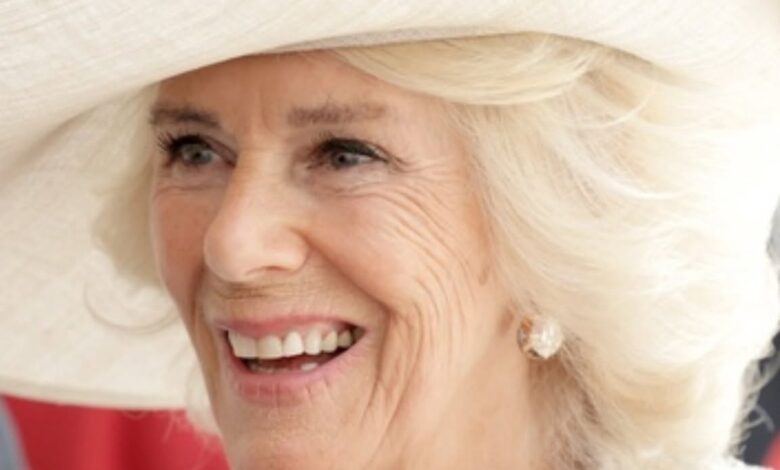
The crown glittered beneath the lights, but it was the woman wearing it who captured everyone’s attention.
As cameras flashed and television crews followed every movement, Camilla stood beside the King with a composure that seemed almost impossible to reconcile with the turbulent history surrounding her name.
For decades, her life had been intertwined with one of the most scrutinized chapters in modern royal history. Old controversies, painful memories, public criticism, and countless newspaper headlines had shaped the way millions of people viewed her.
Yet there she was.
Calm.
Composed.
No dramatic gesture. No attempt to explain herself. No grand declaration that the past had been misunderstood.
Just a woman standing beneath a crown, carrying the weight of a role that once seemed almost unimaginable.
And for many watching, that image created a question that was far more complicated than royal ceremony:
Was this redemption, resilience, or simply the passage of time?
The Woman Behind the Headlines
For years, Camilla existed in the public imagination as a character in someone else’s tragedy.
Her name became inseparable from the story of King Charles III and Diana, Princess of Wales. To many people, she represented the painful third figure in a relationship that had captivated the world.
The media often reduced complicated human relationships to simple roles.
There was the beloved princess.
There was the future king.
And there was the woman many people blamed.
But real lives rarely fit neatly into those categories.
Behind the photographs and headlines was a person who continued living through decades of extraordinary public scrutiny.
Camilla endured criticism that followed her into public appearances, charity events, official engagements, and eventually the royal institution itself.
Every expression could be analyzed.
Every outfit could become a headline.
Every interaction could be interpreted.
And yet, over time, something began to change.
Not necessarily because everyone suddenly forgave her.
Not because the past disappeared.
And certainly not because everyone agreed on the same version of history.
Instead, people simply watched her continue.
Year after year.
Perhaps one of the most striking things about Camilla’s public presence is that she rarely fits the traditional image of a fairy-tale queen.
She does not appear to be someone who stepped out of a storybook.
She often looks like an ordinary woman placed inside an extraordinary institution.
That contrast can be surprisingly powerful.
The monarchy is built around ceremony, symbolism, tradition, and continuity.
There are crowns, robes, grand halls, military ceremonies, state occasions, and centuries of inherited ritual.
But beneath all those symbols is a human being.
And human beings carry history with them.
Camilla’s face, expressions, and manner became reminders that a royal title cannot erase the years that came before it.
The crown may communicate authority.
The ceremony may communicate continuity.
But neither can erase memory.
That is precisely what made her appearance so compelling to many observers.
She did not seem to be pretending that the past had never happened.
Instead, she appeared to be living in the present while carrying the past with her.
There is a temptation to describe royal transformations as if they happen in a single dramatic moment.
One day, someone is controversial.
The next, they wear a crown.
But public opinion rarely changes that quickly.
A title does not automatically create forgiveness.
A ceremony does not erase grief.
And a new chapter does not make previous chapters disappear.
Camilla’s transformation in the public eye unfolded over many years.
It happened through countless ordinary moments rather than one spectacular event.
A charity visit.
A conversation with members of the public.
A speech.
A hospital visit.
A literary event.
A community project.
A formal engagement.
One appearance after another gradually created a different picture.
For people who had once known her primarily through controversy, these repeated images offered something new to consider.
They saw someone carrying out duties.
Someone meeting people.
Someone supporting causes.
Someone aging in public.
Someone continuing despite criticism.
None of these moments erased the past.
But together, they complicated the story.
Time has a strange relationship with public memory.
A photograph from decades ago can remain emotionally powerful, but people themselves continue to age and change.
The world changes too.
New generations grow up with different perspectives.
Old scandals become historical events.
New challenges replace old ones.
And individuals who were once defined by a single chapter of their lives can gradually become associated with something else.
For Camilla, this process was particularly complicated.
She could not simply ask the public to forget.
Nor could she completely control how people interpreted her history.
All she could do was continue with the responsibilities placed before her.
That persistence mattered.
For some observers, it was enough to change their perception.
For others, it was not.
And that division remains part of the story.
There was something almost paradoxical about the way Camilla’s composure could become newsworthy.
Royal appearances are carefully organized.
Clothing is selected.
Schedules are planned.
Speeches are prepared.
Every detail can carry symbolic meaning.
Yet the most memorable moments are often the ones that appear almost ordinary.
A smile.
A quiet conversation.
A moment of laughter.
A glance toward the crowd.
A reassuring gesture.
These small details can humanize a figure who otherwise appears surrounded by layers of ceremony.
Camilla’s public manner has generally emphasized steadiness rather than spectacle.
She does not need to make a dramatic announcement every time she appears.
Her continued presence itself becomes the statement.
She is still there.
Still working.
Still participating.
Still carrying out the role.
Few people experience the kind of public attention that comes with being a senior member of the British royal family.
An ordinary person can have a bad day without millions of strangers analyzing their expression.
A royal cannot always expect that privacy.
A tired look can become a headline.
A change in clothing can become a discussion.
A missed appearance can generate speculation.
A photograph taken at precisely the wrong moment can create an entirely different story.
This environment makes royal life extraordinarily demanding.
It also explains why periods of uncertainty often produce intense public fascination.
When official information is limited, people naturally try to interpret what they can see.
A photograph becomes evidence.
A public appearance becomes a clue.
A change in schedule becomes a subject of speculation.
And social media can amplify all of it within minutes.
This is where the distinction between observation and interpretation becomes important.
Seeing Camilla looking serious in a photograph does not tell us what she was thinking.
Seeing her smile does not reveal what she was feeling.
And seeing her beside the King does not tell us everything about the private reality of their lives.
Public figures are still human beings.
They can be tired.
Distracted.
Concerned.
Amused.
Uncomfortable.
Or simply concentrating.
A single photograph captures only one fraction of one second.
Yet in the world of celebrity and royal coverage, that fraction can become the basis for an enormous narrative.
That is why the most responsible way to understand royal appearances is to separate what is actually known from what is merely being interpreted.
Camilla’s story also demonstrates how difficult it can be for public figures to move beyond a reputation.
Once a particular narrative becomes deeply established, changing it can take decades.
People tend to remember emotionally powerful images.
They remember the photographs that dominated newspapers.
They remember the television coverage.
They remember what they felt when they first heard the story.
Those memories can become remarkably persistent.
But memory is not always the same thing as complete understanding.
As years pass, people gain access to more context.
They may reconsider events they previously understood differently.
They may also decide that their original judgment was correct.
Both reactions are possible.
That is why Camilla’s public evolution is not really a story about everyone changing their minds.
It is a story about a woman continuing to exist within a debate that never had one universally accepted conclusion.
One of the most significant changes in Camilla’s public role has been the shift from being primarily discussed in relation to her personal life to being increasingly associated with official responsibilities.
That transition matters.
Royal duties are repetitive and demanding.
They require showing up even when the event itself is not glamorous.
They involve meeting people from different backgrounds, supporting charitable organizations, delivering speeches, attending ceremonies, visiting communities, and representing the institution.
There is little room for disappearing whenever public attention becomes uncomfortable.
Over time, these responsibilities can create a different kind of public image.
Not necessarily a more glamorous one.
A more functional one.
People begin to see the person not only through the lens of their private history but through the work they perform.
That does not mean criticism disappears.
It means the picture becomes larger.
When Camilla became Queen Consort following the accession of Charles III, the symbolism was enormous.
The woman who had once been one of the most controversial figures surrounding the royal family had entered one of the most visible positions within it.
For some people, that transformation represented acceptance.
For others, it remained difficult to reconcile with memories of the past.
And for many, it was simply an extraordinary example of how dramatically a person’s public position can change over a lifetime.
But becoming Queen did not mean becoming a different person overnight.
She remained the same individual who had experienced decades of criticism, scrutiny, family life, loss, public duty, and personal change.
The title changed.
The responsibilities changed.
The historical position changed.
But the past remained part of her story.
The word “redemption” is tempting.
It creates a powerful narrative.
A controversial woman survives years of criticism and eventually reaches the highest level of royal prominence.
But redemption is deeply subjective.
One person may see resilience.
Another may see rehabilitation.
Someone else may see institutional acceptance.
Another may believe that nothing has been redeemed at all.
There is no single interpretation that everyone must share.
Perhaps the more interesting question is not whether Camilla was “redeemed.”
Perhaps it is whether a person can continue to grow after becoming permanently associated with a controversial chapter of history.
Her life suggests that public identity is not always fixed.
People can change.
Circumstances can change.
Institutions can change.
And public perception can change with them.
There is something powerful about endurance.
Not the dramatic kind.
Not the kind that produces headlines.
But the quiet kind.
The kind that happens when someone wakes up, goes to work, attends the engagement, shakes another hand, listens to another story, and continues doing what is expected of them.
Again.
And again.
And again.
For someone who has spent decades under scrutiny, that persistence can become its own form of strength.
Camilla’s public journey was never going to erase the past.
But neither did the past prevent her from having a future.
That distinction is important.
A person can carry regret and still move forward.
A person can be criticized and still contribute.
A person can have complicated history and still have responsibilities in the present.
Human beings are rarely only one thing.
The crown itself is striking.
The jewels catch the light.
The ceremony creates grandeur.
The setting reminds viewers of centuries of tradition.
But ultimately, the most fascinating part is the person beneath it.
A woman who was once unlikely to occupy such a position now stands at the center of the institution she spent years being associated with from its margins.
The image does not provide a simple ending.
It does not tell everyone what to think.
It does not erase Diana.
It does not erase the controversies surrounding Charles and Camilla.
It does not demand that the public forget.
Instead, it shows something more complicated:
life continued.
Years passed.
People changed.
The monarchy changed.
And Camilla’s role changed with it.
Perhaps that is the most important lesson hidden beneath all the ceremony.
We often imagine that personal transformation requires completely leaving the past behind.
But that isn’t how life usually works.
People carry their mistakes.
They carry their regrets.
They carry memories of difficult periods.
They carry things they cannot change.
What changes is how they live with those things.
Camilla’s public life demonstrates how complicated that process can become when millions of people are watching.
She could not control every headline.
She could not determine how history would remember her.
She could not force everyone to reconsider their opinion.
What she could control, at least to some extent, was how she approached the responsibilities of the present.
And over time, those repeated actions became part of the story too.
A Crown Is Only a Symbol
A crown can represent continuity.
It can represent authority.
It can represent history.
But it cannot automatically create forgiveness, erase grief, or settle every argument.
Those things belong to people.
And people take time to change their minds.
Some never do.
Others do slowly.
Some simply decide that the past is no longer the only lens through which they view someone.
That may be the most realistic way to understand Camilla’s journey.
Not as a fairy tale.
Not as a perfect redemption story.
And not as an attempt to erase what happened.
But as the long, complicated evolution of a woman who spent decades living under extraordinary scrutiny and eventually found herself wearing a crown that once seemed almost impossible.
The cameras still flash.
The headlines still appear.
The debates continue.
But beneath the ceremony stands a woman who has learned that a public life cannot be rewritten with a single photograph.
It can only be reshaped, slowly, through years of choices, responsibilities, endurance, and time.
There are moments in public life when a photograph seems to contain an entire biography.
A woman stands beneath the lights.
She wears a crown that carries centuries of history.
Around her are symbols of tradition, ceremony, and power.
Cameras capture the moment from every angle.
To someone seeing only the image, it might appear to be the conclusion of a remarkable journey.
But real lives do not have such simple endings.
The person standing beneath the crown still carries every chapter that came before it.
The criticism.
The memories.
The difficult years.
The private disappointments.
The moments when the future looked very different from what it eventually became.
And that may be why Camilla’s presence inside the royal institution continues to attract so much attention.
The crown is visible.
The history behind it is not.
Yet both exist at the same time.
For a woman who spent decades being discussed through the lens of a controversial chapter in royal history, occupying such a visible position creates an unusual paradox.
She is expected to represent continuity while also living proof that people and circumstances can change.
She is expected to step into tradition while carrying a personal history that is anything but simple.
And she must do so in full view of a public that remembers differently.
Some remember the controversy.
Others focus on the years of public duty.
Some remain emotionally attached to earlier images of the royal family.
Others have grown up knowing only the present institution.
The result is a story with no single emotional conclusion.
Instead, there is a long process of adaptation.
And perhaps that is where the real story begins.
The Difference Between Being Seen and Being Known
One of the strangest realities of public life is that visibility does not necessarily create understanding.
A person can appear in thousands of photographs and still remain largely unknown to the people looking at them.
This becomes especially true when a public figure has been surrounded by a powerful narrative for decades.
People see the photographs.
They read the headlines.
They hear commentary.
They absorb opinions from television programs, newspapers, conversations, and social media.
Eventually, the narrative becomes familiar.
And once a narrative becomes familiar, it can become difficult to separate the actual person from the image created around them.
Camilla experienced this in an unusually intense way.
For much of her public life, people often encountered her first through the story surrounding her relationship with Charles and the legacy of Diana.
That meant the woman herself could become secondary to the role assigned to her in public imagination.
She was not simply Camilla.
She became a symbol.
And symbols are difficult things to live inside.
A symbol cannot explain itself.
A symbol cannot age naturally.
A symbol cannot ask for nuance.
A symbol is expected to mean something specific.
Human beings, however, are far more complicated.
They change with age.
They learn.
They lose people.
They experience disappointment.
They make mistakes.
They develop different priorities.
And the person who stands before the public decades later may not be the same person the public remembers from decades earlier.
That does not erase history.
It simply means history belongs to a person who continued living.
Growing Older Under a Microscope
There is another element of Camilla’s story that can easily be overlooked.
She has spent a significant portion of her life aging in public.
Most people are allowed to change without an audience.
Their appearance changes.
Their priorities change.
Their energy changes.
Their interests evolve.
They become more confident in some ways and more cautious in others.
Nobody writes an article about every ordinary change in their expression.
Public figures do not have that luxury.
Every stage of life is photographed.
Every formal appearance can become a record.
The transition from youth to middle age to later adulthood happens in front of cameras.
That creates a strange relationship with time.
The public remembers earlier versions of a person in vivid detail, even as the individual continues to move forward.
This can make personal transformation difficult to recognize.
People may continue imagining someone as they were decades ago.
Meanwhile, that person has lived thousands of ordinary days since then.
The effect can be particularly powerful for someone whose identity became associated with controversy at a relatively early point in their public life.
No matter how many years pass, there can always be someone who says:
“I remember what happened.”
And they do.
Memory remains part of public identity.
But so does everything that happened afterward.
When a Reputation Becomes a Permanent Room
Imagine carrying a room with you everywhere you go.
Inside that room are old newspaper stories, television images, opinions from strangers, arguments from decades ago, and emotions that belonged to a particular period.
You cannot lock the room.
You cannot throw it away.
And you cannot stop other people from entering it.
That is one way to understand the burden of a long public reputation.
For Camilla, the old narrative never completely disappeared.
Even after years of public appearances and royal responsibility, it remained available whenever journalists, commentators, or members of the public wanted to revisit the past.
But over time, another room was built beside it.
This one contained something different.
Years of public service.
Formal duties.
Charitable work.
Community appearances.
Official responsibilities.
Moments of interaction with members of the public.
A different kind of record.
The old room did not vanish.
The new one simply became larger.
That is how reputation often changes in real life.
It is not replaced all at once.
It is gradually expanded.
New information is added.
New experiences accumulate.
People begin to remember more than one thing.
And eventually, the original story is still there, but it is no longer the entire story.
The Quiet Power of Repetition
Transformation rarely happens through one dramatic gesture.
It happens through repetition.
Someone does the same difficult thing correctly again and again.
They return to work.
They fulfill responsibilities.
They maintain a certain level of consistency.
They continue even when attention shifts elsewhere.
For someone in public life, this kind of repetition can matter more than a single speech.
One speech can create headlines.
One photograph can go viral.
One emotional moment can dominate public discussion for a week.
But sustained public responsibility creates a much longer record.
And long records are different from dramatic moments.
A dramatic moment tells us what happened that day.
A long record tells us what someone repeatedly chose to do.
That distinction matters when considering Camilla’s evolution within the royal institution.
Her public role did not become significant because of one image beneath a crown.
That image was the visible point of a much longer process.
Years of adjusting to responsibility.
Years of appearing in public.
Years of being scrutinized.
Years of being compared with the woman she could never entirely escape being compared with.
And years of learning how to occupy a role that once seemed almost unimaginable.
The Public Is Not One Person
Another reason Camilla’s story is so difficult to summarize is that there is no single public opinion.
There never has been.
Millions of people can witness exactly the same image and feel completely different things.
One person may see strength.
Another may see compromise.
Someone else may feel indifference.
Another person may remember older events with strong emotion.
A younger viewer may simply see an older royal carrying out official responsibilities.
These reactions can coexist.
They don’t have to cancel one another out.
That is one of the problems with trying to describe a complicated public figure using a single word.
“Beloved.”
“Controversial.”
“Respected.”
“Unpopular.”
“Redeemed.”
“Rejected.”
Such labels may capture part of a reaction, but they cannot fully describe decades of public life.
Camilla’s position within the monarchy has been shaped by people who experienced different periods of royal history differently.
Someone who grew up during one era may carry a very different emotional memory from someone who became interested in the monarchy much later.
Generational experience matters.
Personal experience matters.
Cultural context matters.
Media environments change.
And so the meaning of a royal figure can evolve without ever becoming universally agreed upon.
The Strange Relationship Between Ceremony and Reality
Royal ceremonies are designed to feel larger than ordinary life.
That is part of their purpose.
They create symbolism through clothing, music, formal gestures, historic buildings, and carefully preserved traditions.
But ceremony also creates a fascinating contrast with personal reality.
A crown may look timeless.
The person wearing it is not.
A palace may appear permanent.
The people living within its walls are not.
A national institution may speak in terms of continuity, while individual human beings experience loss, change, aging, and uncertainty.
This contrast becomes especially visible when someone like Camilla appears in ceremonial surroundings.
The crown says:
Tradition.
The woman beneath it says:
Change.
Both messages can be true.
The institution continues.
The individual evolves.
The past remains.
The present unfolds.
And history keeps accumulating.
A Role That Once Seemed Impossible
There was a time when it would have been difficult for many observers to imagine Camilla standing in such a position.
That is not a judgment.
It is simply a reflection of how unexpected the trajectory of her public life became.
Royal history often contains moments that appear almost impossible when viewed from earlier periods.
Relationships change.
Public expectations change.
Institutions adapt.
People occupy positions that previous generations would never have predicted.
Camilla’s journey belongs to that broader pattern.
She moved from being a figure largely defined by personal controversy to becoming part of the formal structure of the monarchy.
That transition did not require everyone to agree about the past.
It simply happened.
The institution changed.
Her role changed.
And the world around her changed as well.
Perhaps that is why the image of the crown can feel so emotionally complicated.
It represents an outcome that would once have seemed improbable.
But it also sits on top of a history that cannot simply be covered by jewels and ceremony.
The Importance of Not Pretending
There is something notable in the absence of dramatic explanations.
Camilla’s public journey was not defined by one speech demanding forgiveness.
There was no single moment that compelled the entire public to forget previous controversies.
Instead, the passage described in the source material is quieter.
She continued.
She appeared.
She carried out responsibilities.
She participated in public life.
She moved forward.
There is an interesting strength in that approach.
When a person has spent years being discussed by others, eventually the only sustainable response may be to continue living rather than constantly responding.
Trying to answer every criticism would be impossible.
Trying to correct every headline would be exhausting.
Trying to control every interpretation would be futile.
Public life would become an endless defense.
But refusing to disappear creates another possibility.
A person can allow time and action to become part of the story.
That does not mean silence always resolves controversy.
It doesn’t.
But it changes the shape of a public life.
The Human Cost of Constant Interpretation
Every public figure is vulnerable to projection.
People place their own beliefs, expectations, disappointments, and hopes onto familiar faces.
Royal figures experience this particularly strongly because the monarchy carries emotional meaning far beyond the individuals within it.
A person can therefore become a symbol of something much larger than themselves.
For Camilla, that symbolism has been especially complicated.
Some people have projected onto her the pain of an earlier royal era.
Others see the institutional evolution that followed.
Still others simply see an individual who has spent years performing public duties.
These interpretations reveal as much about the observers as about the person being observed.
That is why images can be misleading when stripped of context.
A photograph cannot tell you the entire emotional meaning of a life.
It can only show what happened in one visible instant.
Yet public culture often wants instant explanations.
Why is she smiling?
Why does she look serious?
Why is she standing there?
Why did she wear that?
Why did she respond that way?
Sometimes there is no secret answer.
Sometimes a person is simply being a person.
What Happens When You Cannot Escape Your Own History?
For most people, the past gradually becomes private.
Old mistakes are remembered by a shrinking number of people.
Old school photographs disappear into boxes.
Past relationships become stories told occasionally to close friends.
Public figures have a different experience.
Their past remains searchable.
Photographs remain.
Headlines remain.
Video remains.
Quotes remain.
The internet preserves entire periods of a person’s life.
That means public reinvention is never complete.
A person may move forward, but the archive moves with them.
Camilla’s story illustrates this particularly clearly.
No matter how many years pass, people can return to the same earlier chapters.
But the existence of an archive cuts both ways.
It preserves criticism.
It also preserves everything that happened afterward.
It records the evolution.
The new responsibilities.
The later public appearances.
The changes in role.
The passage from one stage of life to another.
The same history that keeps old memories alive also makes long-term change visible.
A Different Kind of Legacy
Legacy is often discussed as though it is something decided at the end of a person’s life.
In reality, legacy is built continuously.
Every public appearance becomes part of the record.
Every role contributes another layer.
Every difficult period becomes part of the story.
For someone in the royal family, legacy is even more complicated because the individual becomes intertwined with an institution that existed long before them and will likely continue after them.
That creates two separate questions.
Who was the person?
And what did the institution ask that person to become?
Those questions do not always have the same answer.
Camilla’s journey can therefore be understood not only as the story of one woman but also as an example of how institutions absorb personal history.
The monarchy has its traditions.
Individuals bring their own experiences.
Eventually, the two become intertwined.
The Woman Beneath the Symbol
Perhaps that is why the most interesting part of the story is not the crown itself.
It is the woman wearing it.
Strip away the title.
Remove the ceremonial clothing.
Ignore the photographers.
What remains?
A person who has lived through decades of intense attention.
A person who has experienced personal relationships under extraordinary public pressure.
A person who has aged while millions watched.
A person who has had to occupy roles that would have seemed improbable earlier in life.
A person who continues to exist within the memory of events that cannot be undone.
This is what makes the story human.
Because most people understand, on a much smaller scale, what it means to carry an earlier version of yourself.
Almost everyone has something in their past they wish had gone differently.
Almost everyone knows what it feels like to be misunderstood.
Almost everyone eventually changes in ways that people from an earlier period of their life might not recognize.
The difference is that most of us get to change privately.
Royal life makes that process public.
Why Time Can Be More Powerful Than Explanation
There are situations in life where words are not enough.
You can explain yourself.
You can defend yourself.
You can apologize.
You can clarify.
And still, some people will remain unconvinced.
Time introduces another variable.
It allows people to observe whether behavior changes.
It allows patterns to emerge.
It allows new generations to form their own impressions.
It allows old controversies to exist alongside newer chapters.
Again, time does not erase facts.
But it changes context.
A person who is remembered only for one controversial period may eventually become known for other things as well.
That doesn’t require rewriting the past.
It simply means the past is no longer the only available information.
And that may be the closest thing to transformation that public life offers.
The Crown and the Passage of Generations
Royal institutions survive partly because each generation inherits symbols from the one before it.
But generations do not interpret those symbols identically.
A crown may mean tradition to one generation.
History to another.
Entertainment to another.
Responsibility to another.
Controversy to another.
Indifference to another.
That diversity of interpretation is inevitable.
Camilla’s position therefore carries different meanings depending on who is looking at her.
Older generations may remember the earlier years vividly.
Middle generations may remember the transition.
Younger generations may encounter the story primarily through historical summaries and current images.
Over time, personal memory becomes historical memory.
That is an important transformation.
A scandal experienced in real time can feel enormous.
Decades later, it may become one chapter among many.
Not necessarily unimportant.
But less dominant.
And this is one reason public identities can evolve even when history remains unchanged.
A Royal Figure Can Never Control the Whole Narrative
There is no realistic way for one person to determine how millions of people will interpret them.
Some stories will be sympathetic.
Some will be critical.
Some will be inaccurate.
Some will be based on facts.
Some will be emotional.
Some will be shaped by personal loyalties.
Others will be shaped by cultural expectations.
For someone inside the royal family, this is particularly difficult because attention is continuous.
Yet perhaps the most sustainable response is not narrative control.
It is consistency.
You cannot control every headline.
But you can control whether you continue to show up.
You cannot control every interpretation.
But you can control how you approach responsibility.
You cannot erase an earlier chapter.
But you can continue writing later ones.
That is not a guarantee of public approval.
It is simply an acknowledgement of what remains within a person’s influence.
When Resilience Is Not the Same as Victory
The word “resilience” often appears when discussing people who endure long periods of criticism.
But resilience should not automatically be confused with triumph.
A resilient person can still carry wounds.
They can still experience difficult memories.
They can still disagree with public narratives.
They can still feel the weight of the past.
Resilience simply means continuing.
And perhaps that is a more accurate way to understand the long arc of Camilla’s public life.
She continued.
The world moved forward.
The monarchy changed.
Her role changed.
The crown eventually became part of the picture.
But nothing about that process requires pretending there was a perfect conclusion.
Life is rarely that neat.
A person can move forward without turning every painful memory into a victory story.
Sometimes survival is simply survival.
Sometimes growth is simply learning how to live with complexity.
What the Public Eventually Sees
At some point, a public figure becomes the sum of many eras.
The person from the old photograph.
The person in the newspaper story.
The person at the charity engagement.
The person standing beside the King.
The older woman beneath the crown.
All of them are the same individual.
None cancels the others.
That is what makes a long life so much more interesting than a single headline.
A headline freezes.
A human being continues.
And Camilla’s story demonstrates precisely that tension.
For decades, she was discussed as though her identity had already been settled.
Yet her life continued.
That continuation became its own form of information.
Not a verdict.
Not a universal answer.
Just evidence that a human story can remain open long after the world thinks it knows the ending.
The Moment After the Cameras Stop
It is easy to focus on the public scene.
The crown.
The lights.
The ceremony.
The cameras.
But public appearances eventually end.
The crowd goes home.
The lights switch off.
The clothes are changed.
The building becomes quiet again.
And the person returns to ordinary life within extraordinary circumstances.
That is where the human part of the story exists.
Not in the perfect photograph.
Not in the ceremonial moment.
But in the hours before and after it.
The person thinking about what has happened.
The memories that return unexpectedly.
The awareness of history.
The knowledge that every appearance may be interpreted by strangers.
And the realization that even the most elaborate ceremony is still only one moment inside a much longer life.
Perhaps that is why the crown itself is such a powerful image.
It looks permanent.
But the person beneath it is living through time.
A Story Without a Simple Ending
There is a temptation to finish a story like this with a declaration.
She was redeemed.
She won.
The public forgave her.
The past no longer mattered.
But none of those statements can capture the complexity of a life that has been publicly observed for so long.
A better ending is more open.
The past happened.
People remember it differently.
Some opinions changed.
Others did not.
Years of public responsibility created new dimensions to her public identity.
The institution changed.
Her position changed.
The world changed.
And time added countless chapters to a story that once seemed to have only one.
That is not a simple ending.
It is a human one.
Perhaps the greatest misunderstanding about public transformation is the belief that the final image is the most important one.
It isn’t always.
Sometimes the journey matters more.
A crown can tell us where someone stands.
It cannot tell us everything about how they got there.
It cannot explain the difficult years.
It cannot reveal every private conversation.
It cannot tell us exactly what someone felt while being criticized.
It cannot show us how time altered their perspective.
It cannot tell us how different generations came to see them.
The crown is simply the visible symbol of one chapter.
The rest is invisible.
And perhaps that is why the image remains so compelling.
A woman once defined in the public imagination by controversy now appears in the center of royal ceremony.
A woman who spent decades being watched now stands beneath one of the most recognizable symbols in the world.
The past is still there.
The present is undeniable.
The future remains unwritten.
And somewhere between all three is the person herself.
What Her Story Says About Change
There is a broader human lesson in the story, although it does not need to be turned into a simple moral.
People are not static.
The person you were ten years ago is not exactly the person you are today.
The public identity created around you can change.
Your responsibilities can change.
Your priorities can change.
Your relationship with the past can change.
And sometimes, the people who thought they understood you years ago may no longer recognize the person you have become.
That does not mean the past was false.
It means people are capable of development.
The difficulty is that public figures have to undergo this development while millions of people are still holding onto old images.
For Camilla, that tension became part of her life.
The old picture remains.
The new picture exists beside it.
Neither can completely erase the other.
The Role of Dignity in a Public Life
Dignity is an unusual quality because it often becomes most visible when a person is under pressure.
It is not necessarily loud.
It does not require a dramatic speech.
Sometimes it appears as restraint.
A refusal to respond to every provocation.
A willingness to continue with responsibilities.
A calm presence in an environment where every movement is watched.
That kind of demeanor can change the emotional temperature of a public appearance.
It does not force anyone to agree.
It does not settle old disagreements.
But it can demonstrate how someone chooses to conduct themselves now.
And over many years, those choices can become part of a person’s public identity.
The Lasting Question
So when viewers look at Camilla beneath the crown, perhaps the most interesting question is not whether the image represents victory.
It may be something much harder to answer:
What does a lifetime of change look like when the past is always visible?
There is no universal answer.
For some observers, the image may represent an extraordinary evolution.
For others, it may be an uncomfortable reminder of history.
For some, it may simply be another royal ceremony.
And all of those reactions can exist at the same time.
The image does not need to settle the argument.
It is enough that it shows how far the story has traveled.
Eventually, every public symbol becomes secondary to the person behind it.
The jewels can be documented.
The ceremony can be photographed.
The history can be studied.
But a human life remains larger than the symbols surrounding it.
Camilla’s story has been shaped by relationships, criticism, public expectations, institutional tradition, and the relentless passage of time.
It has also been shaped by something much simpler.
She continued.
She continued living.
She continued appearing.
She continued taking on responsibilities.
She continued moving through a world that remembered her earlier life.
That continuation does not demand agreement from anyone.
It simply exists.
And perhaps that is why the image of the crown can feel so much more complicated than it first appears.
Beneath the glitter is history.
Beneath the history is a person.
And beneath the person is a lifetime that cannot be reduced to one relationship, one photograph, one controversy, or one title.
The crown may be the most visible part of the image.
But it is not the whole story.
The Story Time Tells
Time does not rewrite history.
It adds to it.
Every year becomes another page.
Every responsibility becomes another line.
Every public appearance becomes another photograph.
Every generation brings another interpretation.
Eventually, a person who once seemed defined by one chapter can become associated with an entire lifetime.
That is where Camilla’s story now sits.
Not at the beginning.
Not at the moment of greatest controversy.
Not even at the moment when the crown first appeared.
But somewhere much further along the road.
A road shaped by choices, circumstances, criticism, responsibility, and time.
And perhaps the most revealing thing about that road is that there was never one magical moment when everything changed.
There was no single gesture that erased history.
Instead, there were years.
Years of movement.
Years of adjustment.
Years of living beneath scrutiny.
Years of allowing a public identity to develop beyond the boundaries of an old narrative.
That is how most real change happens.
Slowly.
Unevenly.
Without a soundtrack.
Without certainty.
And often without anyone realizing it is happening until they look back.
The cameras eventually stop.
The crowds eventually leave.
The ceremony eventually ends.
Even the brightest crown eventually returns to its case.
What remains is the story.
And stories are rarely as simple as the headlines that introduce them.
Camilla’s public journey began long before the crown became part of the picture.
It passed through controversy, scrutiny, criticism, changing expectations, and years of public responsibility.
It now exists in a different chapter.
But the earlier chapters remain.
That is not necessarily a flaw in the story.
It may simply be what makes it human.
Because people do not get to choose which chapters the world remembers.
They only continue writing the ones that come next.
And perhaps that is the quiet truth hidden beneath the glitter of the crown:
A title can change overnight.
A public role can change over time.
But a life is never defined by one moment alone.
The woman beneath the crown remains a person shaped by everything that came before it.
The past did not disappear.
The future did not arrive fully formed.
And the journey between them became the story itself.
For decades, millions of people watched Camilla through the lens of a complicated chapter in royal history.
Today, they can also see something else.
A woman who continued through the years.
A woman who entered a role that once seemed almost impossible.
A woman whose public identity evolved without requiring everyone to agree on the past.
Whether someone interprets that evolution as resilience, responsibility, institutional continuity, or simply the natural passage of time is a matter of personal perspective.
But one thing is undeniable within the story:
The woman who once stood at the edge of the royal narrative eventually became part of its center.
And the most remarkable part was not the glitter.
Not the ceremony.
Not even the crown.
It was the extraordinary distance between who the world once thought she was and the woman standing there decades later.
The past remained behind her.
The cameras remained in front of her.
And for perhaps the first time, the image made one thing unmistakably clear:
Her story had never really been about the crown.
It had always been about what happens when a person keeps moving forward while the world keeps looking backward.