
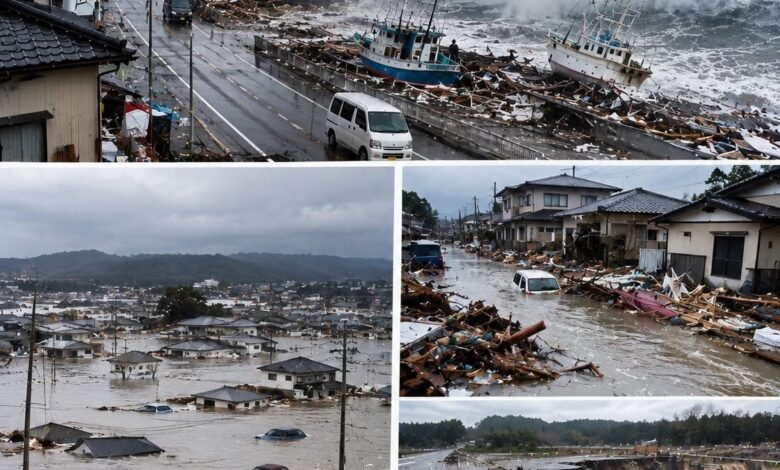
The following is a fictional disaster narrative set in Miyako, Japan. The events, earthquake, tsunami, casualties, and destruction described below are fictional and should not be interpreted as a report of a real earthquake occurring in Miyako.
Chapter 1: An Ordinary Morning Turns Into a Nightmare
At first, nobody in the coastal city of Miyako understood what was happening. It was an ordinary morning. Families were preparing breakfast, workers were getting ready for their daily routines, and children were heading to school. The streets were beginning to fill with traffic, while the ocean remained calm beyond the coastline.
Then came a strange vibration.
A glass trembled on a kitchen table. Hanging lights began to swing, and dishes rattled inside cupboards. Some residents initially thought a heavy truck was passing nearby. But within seconds, the movement became stronger.
The floor shifted beneath people’s feet. Windows shook violently, furniture moved across rooms, and objects fell from shelves. Suddenly, the entire city was overwhelmed by the deep roar of a powerful earthquake.
In this fictional scenario, the earthquake registered an extraordinary magnitude of 9.1 beneath the Pacific Ocean. Its force was so overwhelming that people struggled to remain standing. Parents grabbed their children, elderly residents held onto furniture, and neighbors shouted to one another through the noise.
Outside, utility poles swayed, power lines twisted, and parked vehicles bounced against the pavement. Glass shattered across sidewalks. Some buildings suffered visible damage, while others lost electricity almost immediately.
For what felt like an eternity, ordinary life disappeared beneath the shaking ground.
Then the strongest movement gradually weakened.
A frightening silence followed.
People slowly stepped outside, looking at damaged buildings and trying to understand what had happened. Some immediately called relatives. Others searched for neighbors who might need help. But communication networks were already becoming overloaded.
Before residents could fully assess the earthquake damage, emergency sirens began sounding across the city.
A tsunami warning had been issued.
For people living near the coast, the message was terrifyingly clear. The earthquake might have been only the beginning of a much larger disaster.
Emergency announcements instructed residents to move immediately toward higher ground. Parents gathered their children, neighbors helped elderly people leave their homes, and drivers abandoned vehicles when roads became crowded.
Many people took only essential belongings: medicine, documents, drinking water, and emergency bags. Others left with nothing but the clothes they were wearing.
One fictional family, the Tanakas, had been eating breakfast when the earthquake struck. Their youngest daughter, Hana, was terrified. Her father took her hand while her mother grabbed an emergency bag they had prepared months earlier.
The apartment elevator was no longer working, so the family rushed down the stairs. Outside, neighbors were already moving toward the evacuation route. An elderly man struggled to walk, and two younger residents stopped to help him.
Hana looked back toward their apartment.
“Are we coming back?” she asked.
Her mother hesitated before answering.
“We’re going somewhere safe first.”
Nobody knew what would happen to their home. At that moment, survival was the only priority.
Along the coastline, the ocean began behaving strangely. The water slowly pulled away from the shore, exposing wet sand and areas that were normally underwater. Small boats tilted awkwardly, while fish appeared in places where seawater had been only moments earlier.
Some people stopped to look. Others began recording the unusual sight.
But those who understood the danger immediately urged everyone to run.
A tsunami was approaching.
In the distance, a broad wall of water was moving toward the coast. It did not resemble an ordinary ocean wave. It was darker, wider, and carried an enormous amount of energy.
The first wave was about to reach Miyako.
Chapter 2: The Ocean Swallows the Coastline
The approaching tsunami reached the seawall with tremendous force. For a brief moment, the barrier appeared to hold. Then the water surged higher, spilling over and rushing into the streets.
The sound was deafening.
Vehicles began moving across flooded roads. At first, parked cars rolled slowly. Moments later, they floated, collided, and spun through intersections. A small truck was pushed sideways while debris from buildings and damaged structures moved through the water.
The coastline became almost unrecognizable.
Water poured into low-lying neighborhoods, filling streets and entering homes. Residents who had not evacuated quickly enough scrambled toward staircases, upper floors, and any available high ground.
Emergency workers continued shouting instructions, directing people away from dangerous areas. The city had become a maze of muddy water, debris, damaged buildings, and confusion.
The Tanaka family continued climbing toward higher ground. Hana’s father held her hand tightly while her mother carried the emergency bag. Behind them, the sound of rushing water grew louder.
They passed people helping elderly neighbors and children who had become separated from their parents. Nobody stopped to collect unnecessary belongings. Everyone understood that returning toward the coast could be deadly.
Meanwhile, another crisis was developing across the city.
The earthquake had damaged electrical infrastructure. Traffic signals stopped working, streetlights disappeared, and entire neighborhoods were plunged into darkness. Some emergency facilities managed to activate backup generators, but other buildings lost power completely.
Elevators stopped. Pumps struggled to operate, and communication equipment became unreliable.
Thousands of residents attempted to contact relatives simultaneously. Calls failed, messages remained unsent, and some phones displayed no signal at all.
For many families, not knowing whether loved ones were safe became almost as frightening as the physical destruction.
At one evacuation center, a woman named Keiko stood near the entrance, repeatedly checking her phone. Her husband had been working near the waterfront when the earthquake struck.
His last message had been brief:
“I’m okay. We’re evacuating.”
Then communication stopped.
Keiko called him again and again, but there was no answer. Every time someone entered the shelter, she looked up, hoping to see him.
Around her, other families were experiencing the same uncertainty. Parents searched for missing children, elderly residents worried about relatives in different neighborhoods, and volunteers tried to organize information with limited resources.
Roads were flooded or blocked by debris. Bridges were damaged, and emergency crews had to prioritize the most urgent rescue operations.
Just as some residents began believing the worst had passed, another warning came.
Additional tsunami waves were possible.
Authorities urged everyone to remain away from the coastline. This instruction was important because a tsunami does not necessarily arrive as one single wave. Later waves may be larger than the first, and dangerous currents can continue even after the water begins retreating.
Some residents wanted to return home to retrieve medicine, documents, or personal belongings. Others wanted to inspect their businesses.
But emergency personnel repeated the same message: the coast was still dangerous.
From higher ground, Miyako looked like a different city. Buildings stood partially submerged, vehicles were scattered across roads, and household belongings floated through flooded neighborhoods.
The places where people had walked to work, school, and local shops only hours earlier were now covered in water and debris.
The disaster was far from over.
Chapter 3: Rescue Operations and the Longest Night
As conditions gradually allowed, emergency teams began moving into affected areas. Their work was extremely dangerous. They had to navigate unstable buildings, flooded streets, damaged roads, and piles of debris while remaining alert to the possibility of additional waves.
Rescuers searched damaged structures, called out to survivors, and listened carefully for any response.
Sometimes they heard only silence.
Then, occasionally, a faint voice or a knock came from somewhere inside a damaged building.
One rescue team approached a partially flooded structure after hearing a sound from an upper floor. They climbed carefully and discovered a family that had been trapped for hours.
The children were exhausted and frightened. When the rescuers finally reached them, one firefighter crouched down and reassured them.
“You’re safe now.”
The youngest child began crying. She had been trying to remain brave for so long that she only allowed herself to cry when she realized help had finally arrived.
Across Miyako, evacuation centers became temporary homes. Schools, community buildings, and gymnasiums were filled with residents who had lost access to their houses.
Classrooms became sleeping areas. Blankets covered gymnasium floors, while hallways were used to organize food, medicine, and emergency supplies.
Volunteers distributed drinking water and warm clothing. Medical teams treated minor injuries, and local residents helped elderly people move to quieter areas.
Small acts of kindness became essential.
A stranger handed a frightened child a bottle of water. A teenager carried supplies for an elderly woman. A restaurant owner shared whatever food remained available, while a teacher organized children into groups so their parents could search for relatives.
The city had suffered enormous physical damage, but its residents were beginning to show how strongly a community could respond to disaster.
That night became the longest night many people could remember.
Occasional aftershocks continued to shake the ground. Every sudden movement made residents look toward the ceiling or reach for their children. Some people slept sitting against walls, while others remained awake beside family members.
Outside, emergency vehicles continued moving through dark streets. Helicopters could be heard overhead, and generators provided electricity in selected facilities.
There were no ordinary evening activities. No crowded restaurants, no shopping, and no familiar traffic sounds. The city had lost its normal rhythm.
For Keiko, the uncertainty continued for hours. She remained near the shelter entrance, holding her phone and hoping for news about her husband.
Then, close to midnight, the phone vibrated.
A message appeared.
It was from him.
“I’m alive. I’m at another shelter. I can’t leave yet.”
Keiko covered her mouth and began crying. When another woman beside her asked whether he was safe, Keiko nodded.
“He survived.”
For the first time since the earthquake, she smiled.
But she knew that many other families were still waiting for information. Her relief existed alongside the fear and uncertainty of people who had not yet heard from their loved ones.
When daylight finally returned, the damage became even more visible.
Mud covered roads. Vehicles were piled against buildings. Windows were shattered, walls had collapsed, and electrical cables lay tangled in some areas. Fishing equipment had been carried inland, while shops and homes were filled with water and debris.
Residents stood silently looking at their neighborhoods. Some cried. Others began cleaning immediately. Many simply did not know where to start.
The emergency was slowly changing into a much longer struggle: recovery.
Chapter 4: The Human Cost and the Difficult Road to Recovery
The physical destruction was easy to see. The emotional consequences were much harder to measure.
People experienced fear, confusion, exhaustion, and grief. Some struggled to sleep. Others became frightened whenever they heard a vibration or a sudden loud noise.
Children repeatedly asked whether another earthquake was coming. Parents tried to reassure them, even when they did not have all the answers.
The Tanaka family eventually returned to an area where they could inspect their damaged home, once authorities permitted access. Their belongings had been scattered, and mud covered parts of the apartment.
Hana’s mother found a family photograph among the damaged possessions. The frame was broken, but the picture was still recognizable. She carefully placed it inside a plastic bag.
For the family, recovering that small photograph felt important. It represented a part of their ordinary life that had survived the disaster.
Elsewhere, an older fisherman named Sato returned to inspect the harbor. He had spent most of his life working on the ocean, which had provided his family with food and income for decades.
Now several boats were damaged, equipment was scattered, and the docks were covered with debris.
He stood quietly for several minutes before saying:
“The ocean gives us life. Sometimes it reminds us how powerful it is.”
His words reflected the complicated relationship coastal communities have with the sea. The ocean provides employment, food, transportation, and identity, but it can also become extremely dangerous during a major natural disaster.
Meanwhile, the city’s infrastructure crisis continued.
Roads needed repairs. Electrical networks had to be restored, and water systems required inspection. Businesses could not operate normally, schools remained closed, and transportation was interrupted.
Even simple tasks became difficult. Finding medicine could take hours. Charging a phone required patience, and obtaining reliable information sometimes depended on battery-powered radios.
The disaster demonstrated how interconnected modern life had become. When electricity fails, communication systems may also be affected. When roads are blocked, emergency supplies become harder to deliver. When water systems are damaged, even temporary shelters face additional challenges.
Volunteer networks became an important part of the recovery process.
Local businesses donated supplies. Students carried food and water. Medical professionals worked long shifts, while teachers helped organize temporary learning spaces. Neighbors checked on elderly residents and people living alone.
Some volunteers had lost homes themselves, yet still found ways to help others.
Recovery did not happen overnight. Buildings needed inspections, roads required repairs, and damaged homes had to be cleaned or rebuilt. Families faced the difficult task of replacing documents, appliances, furniture, vehicles, and countless personal belongings.
The emotional recovery could take even longer.
For some residents, returning to everyday routines would take months. Others might need years to feel secure again. A familiar street could suddenly remind someone of the disaster, while a quiet ocean might bring back memories of the approaching wave.
Children needed reassurance that adults were working to keep them safe. Families needed support, and residents needed time to understand what they had experienced.
The disaster was no longer only about surviving the earthquake and tsunami. It was about learning how to live afterward.
Chapter 5: The Lessons Miyako Would Never Forget
As the weeks passed in this fictional account, residents began asking an important question:
Could something like this happen again?
Communities in earthquake-prone regions must always take future seismic activity seriously. Aftershocks can occur, and additional tsunami hazards may exist after a major offshore earthquake. The exact timing of future earthquakes cannot be predicted with certainty.
That uncertainty can be frightening, but it does not mean people are helpless.
Preparedness can reduce risk.
Knowing evacuation routes matters. Understanding tsunami warnings matters. Keeping emergency supplies available matters. Having a family communication plan matters. Knowing where higher ground is located can make a critical difference when time is limited.
One of the most important lessons from the fictional Miyako disaster was the value of immediate evacuation.
People should not wait to see a tsunami before moving to safety when an official warning or evacuation instruction has been issued. They should not travel toward the coastline to watch the water, return home to collect belongings, or assume the danger has ended after the first wave.
Tsunamis can arrive in multiple waves, and later waves may be more dangerous. Strong currents can remain hazardous long after the first surge has passed.
In the months following the disaster, Miyako began changing its approach to preparedness. Emergency drills became more meaningful. Families reviewed their evacuation plans, schools taught children where to go, and businesses considered how they could operate during emergencies.
For younger residents, the event became a story passed down by parents and grandparents.
They would ask where their families had been, how they had escaped, and who had helped them. Every family would have a different account. Some stories would be heartbreaking, others hopeful, and some almost impossible to believe.
Hana, the young girl from the Tanaka family, eventually returned with her parents to a safe location overlooking the ocean.
The water was calm. Waves moved gently along the coastline, and the horizon looked almost exactly as it had before the disaster.
Hana stared at the sea for a long time.
“Is the ocean angry?” she asked her father.
He thought carefully before answering.
“No. Sometimes nature is powerful in ways we cannot control.”
She was quiet for a moment.
“Can we still love the ocean?”
Her father smiled.
“Yes.”
They stood together, holding hands and watching the waves.
Months after the fictional disaster, signs of recovery began appearing throughout the city. Construction workers repaired roads, shops reopened, and schools gradually welcomed students again. Some buildings had disappeared entirely, but new lights were beginning to appear in neighborhoods that had once been dark.
Life was returning, although it was not exactly the same life residents had known before.
The city had changed. Its people had changed. But the determination to rebuild remained.
The most important moments of the disaster had not necessarily been the moments when the largest waves arrived. They were the minutes before the water reached the coast, when residents heard warnings and decided whether to evacuate.
Those minutes mattered.
A tsunami can move rapidly across coastal areas, leaving little time for hesitation. Preparedness means turning the available warning time into meaningful distance from danger.
The fictional earthquake and tsunami in Miyako ultimately became a story about more than destruction. It was about families searching for one another, rescue workers risking their safety, neighbors sharing supplies, and ordinary people finding the courage to begin again.
The wave received the attention. The earthquake became the headline. The damaged buildings became the images people remembered.
But recovery happened quietly.
It happened when a shop reopened, when a child returned to school, when a fisherman repaired his boat, and when a family finally slept in a repaired home again.
It happened one street, one building, and one family at a time.
The ocean eventually looked ordinary again. Birds returned to the coastline, boats moved across the water, and the sun continued rising over the Pacific.
But those who had lived through the fictional disaster would never forget the sirens, the shaking ground, the retreating water, or the desperate journey toward higher ground.
They had learned that ordinary life could change in minutes, but rebuilding a community required patience, cooperation, and determination.
The water had retreated.
The city had been wounded.
But the story was not over.
It was only beginning again.
Chapter 6: Rebuilding More Than Homes
In the weeks that followed the disaster, Miyako slowly began to discover what recovery truly meant. The first days had been dominated by survival: finding missing relatives, locating clean water, treating injuries, and searching through the remains of damaged buildings. Now, as emergency teams gradually reduced their presence, a different challenge emerged. The people who had survived needed to rebuild their lives in a place that no longer looked or felt familiar.
For many families, returning home was impossible. Entire neighborhoods had disappeared beneath debris, while other areas remained unsafe because of damaged foundations, unstable structures, and the possibility of additional coastal flooding. Temporary shelters provided protection, but they could not replace the comfort of a familiar bedroom, a family kitchen, or the quiet routines that had once made everyday life feel secure.
Keiko was among those struggling with this new reality. She had spent the first nights searching for information about her husband, hoping that someone from the rescue teams would bring reassuring news. When they finally reunited, relief overwhelmed every other emotion. Yet their reunion did not erase the losses around them. Their home had been destroyed, and many of the possessions they had collected throughout their marriage were gone.
At first, Keiko found herself worrying about small things. She wondered whether they would ever recover their family photographs, whether she would be able to cook in her own kitchen again, and whether the familiar sounds of the neighborhood would return. Eventually, she understood that these questions were part of a much larger process. She was not simply mourning a building. She was mourning the life that had existed inside it.
Across Miyako, similar experiences unfolded. Elderly residents struggled with the uncertainty of temporary accommodation. Parents tried to explain the disaster to frightened children. Business owners examined damaged shops and wondered whether they had enough resources to reopen. Fishermen faced the difficult question of whether returning to the sea would be safe or economically possible.
The local authorities, volunteers, engineers, and community organizations began coordinating long-term recovery efforts. Their priorities included restoring essential services, assessing damaged infrastructure, providing temporary housing, and identifying safer locations for future residential development. Every decision required careful consideration because rebuilding exactly what had existed before could leave the community exposed to similar dangers.
Chapter 7: Hana and the Meaning of a New Beginning
For Hana, the disaster became a defining moment in her childhood. Before the earthquake, she had thought of safety as something permanent. Her home was where she slept, her school was where she learned, and the coastline was simply part of the landscape she had known all her life.
After the tsunami, those assumptions changed.
At the temporary shelter, Hana often asked her mother why the ocean had moved so far inland. Her questions were difficult to answer. Keiko tried to explain that powerful earthquakes beneath the sea could displace enormous amounts of water, creating waves capable of traveling across the coastline with tremendous force. She also explained that warnings and evacuation procedures existed to give people time to reach safer ground.
But Hana wanted to understand something more personal. She wanted to know whether the ocean would ever become dangerous again.
Keiko did not promise that another disaster would never happen. Instead, she told her daughter that people could learn from what had happened and prepare more effectively for the future. They could recognize warning signs, understand evacuation routes, participate in emergency drills, and help one another when danger appeared.
That answer gradually changed Hana’s perspective. She began paying attention whenever volunteers discussed disaster preparedness. At school, when classes eventually resumed, she listened carefully to lessons about earthquakes, tsunami warnings, and emergency communication. She learned that preparation was not an expression of fear. It was a practical way of protecting lives.
Other children in the community experienced similar changes. Some had lost friends or relatives, while others had been separated from their homes for months. Teachers and counselors worked to provide emotional support, recognizing that children might express distress through silence, anger, sleep difficulties, or repeated questions.
The rebuilding process therefore had to include more than roads, buildings, and public facilities. It also required restoring confidence. Children needed places where they could play without constantly thinking about the disaster. Families needed opportunities to reconnect with neighbors. Older residents needed reassurance that they would not be forgotten as the town changed.
Chapter 8: The Fisherman Who Returned to the Water
Sato had spent most of his life connected to the sea. Fishing was not merely his occupation; it was a tradition passed down through generations. He understood the coastline through years of observation, recognizing changes in the weather, the movement of currents, and the seasonal behavior of fish.
Yet after the tsunami, approaching the water became emotionally difficult.
His fishing equipment had been damaged or swept away. Several familiar coastal structures had vanished, and the harbor had suffered extensive destruction. Even when the sea appeared calm, Sato could not look at it without remembering the violent movement of water that had transformed his community.
For a long time, he questioned whether he should continue fishing. The work represented his identity, but it also reminded him of how vulnerable people could be when nature became unpredictable.
Eventually, Sato joined discussions with other fishermen and local recovery officials. They examined the condition of the harbor, reviewed safety procedures, and considered what equipment would be necessary before fishing operations could resume. The process was slow, and uncertainty remained.
When he finally returned to the water under safer conditions, it was not a triumphant moment. He moved carefully, checked his equipment repeatedly, and remained attentive to official warnings. His first trip was modest, producing far less than he would once have expected.
Nevertheless, it represented something important.
Sato realized that returning to the sea did not mean forgetting what had happened. It meant accepting that his relationship with the ocean would be different. He could respect its power while continuing to value the livelihood and traditions it had given his community.
His experience became an example for younger residents who were considering whether traditional industries could survive the disaster. Recovery would require new safety standards, better communication, and practical cooperation, but it did not necessarily mean abandoning the town’s identity.
Chapter 9: Remembering Without Living in Fear
As months passed, Miyako began to hold gatherings to remember those who had died and recognize the people who had helped during the emergency. These events were emotional. Some residents spoke publicly about their experiences, while others preferred to remain quiet.
For many survivors, remembering was complicated. They wanted to honor lost family members, but they also needed to move forward. They understood that grief did not follow a fixed schedule. A person could feel hopeful one morning and overwhelmed by sadness the next.
Community leaders encouraged residents to preserve personal stories, photographs, and records of the disaster. These memories could help future generations understand not only the destruction but also the decisions that had saved lives.
The fictional town’s recovery also highlighted the importance of reliable information. During a major emergency, rumors and inaccurate reports can create confusion. Residents need clear instructions from trusted authorities, accessible warning systems, and communication methods that remain useful when electricity or mobile networks are disrupted.
Preparedness became a shared responsibility. Families discussed evacuation plans, schools practiced emergency procedures, and community groups identified residents who might need assistance during a future evacuation, particularly older people and individuals with disabilities.
The disaster had changed Miyako, but it had also strengthened the community’s determination to protect one another.
Chapter 10: A Future Built on Lessons Learned
One year after the fictional disaster, Miyako was still recovering. Not every road had been restored, not every business had reopened, and not every family had found permanent housing. Some residents had chosen to relocate, while others remained committed to rebuilding their lives in the community.
The coastline looked different, and the town’s familiar rhythm had changed. Yet signs of renewal were beginning to appear. Children returned to classrooms, small businesses reopened, and neighbors gradually established new routines.
Hana visited a public gathering with her mother and listened as residents discussed the future. She noticed that the adults no longer spoke only about what had been destroyed. They also talked about safer construction, improved evacuation routes, stronger community networks, and the importance of teaching children how to respond to emergencies.
Keiko looked at her daughter and realized how much had changed. Hana was still young, but she understood that safety required preparation and cooperation. She also understood that rebuilding was not something that happened automatically. It depended on people making difficult decisions and supporting one another over time.
For Sato, the future remained connected to the sea. He continued working carefully, sharing his knowledge with younger fishermen and encouraging them to take warnings seriously. He knew that no community could completely control the forces of nature, but it could reduce its vulnerability through planning and awareness.
The story of Miyako was therefore not simply a story of destruction. It was a story about the people who faced uncertainty, endured loss, and gradually began again.
The fictional magnitude 9.1 earthquake and tsunami described in this account serve as a reminder of how quickly an ordinary morning can become a life-changing emergency. They also highlight why disaster education, early-warning systems, evacuation planning, and community support are essential.
The town could not recover everything it had lost. Some homes would never return, some familiar streets would remain changed, and some absences would always be felt. But the people of Miyako carried forward something that the disaster could not erase: their determination to protect one another and build a safer future.
And as another morning arrived over the coastline, the residents began their day with a different understanding of what mattered most. They knew that ordinary moments were precious, that preparation could save lives, and that even after devastating loss, a community could find the strength to begin again.